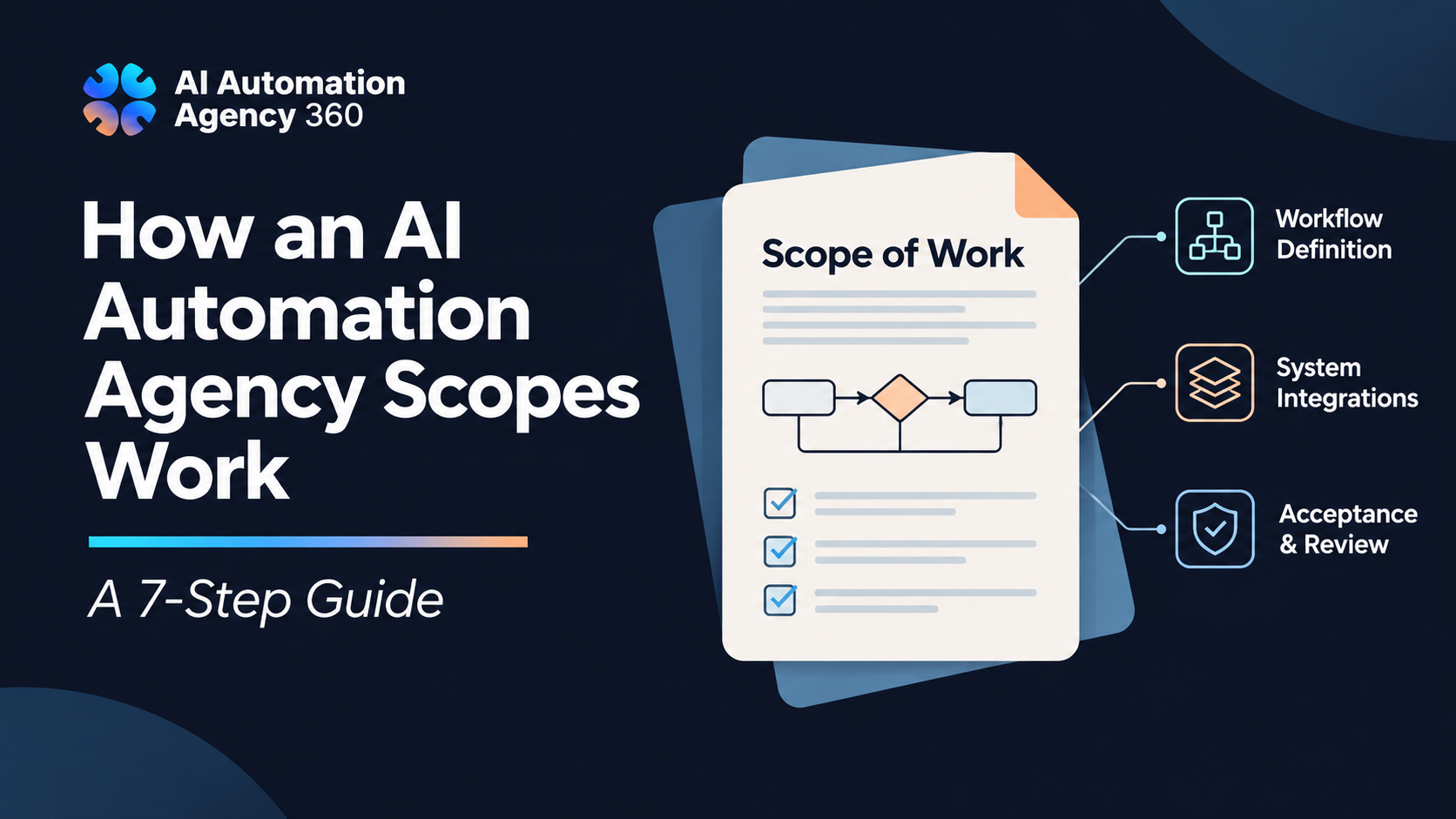
How an AI Automation Agency Scopes Work: A 7-Step Guide
November 21, 2026 By Team AI Automation Agency 360
Short answer: A good AI automation agency qualifies the workflow, documents the existing process, and maps the proposed automation from trigger to output. It assesses data readiness, integrations, and compliance requirements, then defines acceptance criteria, failure handling, and the boundaries of the first release. These requirements are consolidated into a scope of work that both parties approve before development begins.
Before investing in AI automation, one document deserves as much attention as the agency's pricing or delivery timeline: its scope of work.
An automation project may sound straightforward. You identify a repetitive process, explain what you want to improve, and receive a proposal. But what happens when customer data is inconsistent, an integration doesn't support the required actions, or an AI agent encounters a situation it cannot resolve?
These details can determine the actual cost, complexity, and reliability of the solution.
A well-defined scope establishes what the automation will accomplish, how it should operate, what your business needs to provide, and how both parties will determine whether the project has succeeded.
This guide explains how an AI automation agency scopes work, the technical documentation you should expect, and the details that distinguish a production-ready proposal from an expensive experiment.
TL;DR
- Qualify first: confirm the workflow is worth automating and whether it needs AI at all, or just rules, scripts, or RPA.
- Map the as-is process: document real steps, exceptions, and baseline metrics such as time, volume, error rate, and cost per instance.
- Design the to-be workflow: define triggers, inputs, decisions, output schemas, and human-in-the-loop approval points.
- Check feasibility: assess data readiness, integrations, security, and compliance before estimates are finalized.
- Make success measurable: set acceptance criteria, failure handling (soft, hard, cascading), rollback, and edge-case tests.
- Limit the first release: scope a minimum viable automation, state exclusions and responsibilities, and use change control.
- Put it in writing: consolidate everything into a scope document both parties approve before development starts.
Why Proper Scoping Matters Before AI Development
AI automation inherits the logic, bottlenecks, and gaps of the process underneath it. Choosing an AI model before understanding these requirements puts technology ahead of the business problem.
Consider a customer support workflow.
Employees receive enquiries, check customer records, review company policies, and decide whether to respond or escalate the issue. An AI agent could automate parts of this process, but its effectiveness depends on how well those activities are defined.
If escalation rules are unclear or customer information is inconsistent, the automation may reproduce those problems at scale.
Poorly defined requirements can also lead to additional development work, integration changes, unexpected operating costs, and disagreements about project deliverables.
In June 2025, Gartner predicted that more than 40% of agentic AI projects would be canceled by the end of 2027, citing escalating costs, unclear business value, and inadequate risk controls. This is a forecast rather than an observed failure rate, but it reinforces why feasibility and business value should be established before development.
Proper scoping helps answer three questions:
- Is the workflow worth automating? Expected business value should justify implementation and maintenance costs.
- Can it be automated reliably? Required data, integrations, technical capabilities, and safeguards must be available or achievable.
- What does successful implementation look like? Both parties need agreed deliverables, performance requirements, and acceptance conditions.
The objective isn't to eliminate every uncertainty. It's to identify important unknowns, validate what can be validated, and make remaining assumptions explicit.
That work begins during discovery.
What Happens During AI Automation Discovery?
AI automation discovery is the initial assessment of a business process, its automation potential, and implementation requirements.
It helps businesses move from a broad objective, such as "automate our invoice processing," to a defined solution with clear technical and operational requirements.
Depending on the project, discovery may be a separate paid engagement or part of a broader development agreement.
An agency should use discovery to evaluate:
- The business problem and intended outcome.
- Existing workflows, manual steps, approvals, and exceptions.
- Systems, applications, and information required.
- Opportunities for AI, rule-based automation, or RPA.
- Technical dependencies, security requirements, and implementation risks.
- Expected deliverables, costs, timelines, and responsibilities.
What should you receive after discovery?
A useful discovery phase should produce documentation that supports an informed investment decision.
| Deliverable | What it should explain |
| Process and systems map | Existing workflows, applications, responsibilities, and dependencies |
| Prioritized automation opportunities | Workflows ranked by business value, feasibility, and risk |
| Technical specification | Proposed architecture, workflow, integrations, and controls |
| Implementation proposal | Deliverables, scope boundaries, timeline, costs, and acceptance criteria |
Discovery reduces the risk of committing to development before critical requirements are understood.
For example, a seemingly simple AI agent may require extensive data preparation or integration with a legacy application. Identifying those dependencies early allows the project scope and budget to reflect the actual work.
Not sure where your business should start with AI automation?
If your leadership team has identified several opportunities but doesn't have the evidence to prioritize them, our 360 Automation Audit can help turn those ideas into an investment plan.
Over three weeks, AI Automation Agency 360 assesses 10 or more opportunities, evaluates potential ROI, and develops a detailed implementation plan for the strongest one. You receive a ranked opportunity register and a fixed-price build proposal to support your decision.
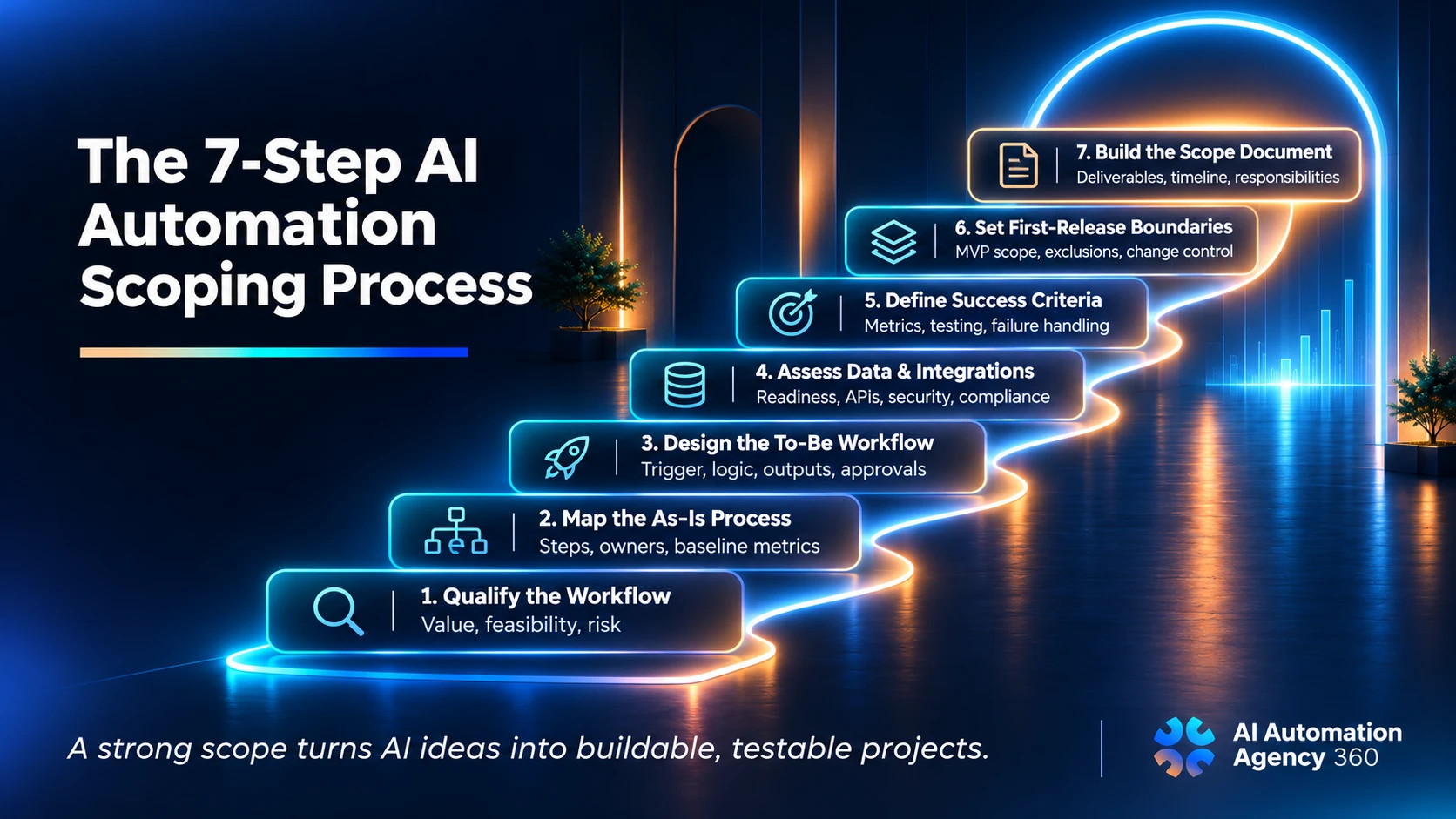
The 7-Step AI Automation Scoping Process
Scoping an AI automation project involves more than identifying a workflow and estimating development costs. It sets the direction for everything else an agency delivers, from workflow builds and system integrations to testing, launch, and ongoing support. Understanding what an AI automation agency does across those stages helps you see why a weak scope causes problems later.
Before implementation, an agency needs to understand how the process operates today, determine what should be automated, and establish how the proposed solution will perform in real business conditions.
The process can be organized into seven stages, from qualifying the opportunity to documenting technical requirements, deliverables, and acceptance criteria.
Here's what happens at each stage and what your business should expect.
1. Qualify the Workflow for AI Automation
The first step is determining whether the workflow justifies automation and whether AI is necessary.
Not every repetitive task needs an AI agent. Some are better handled through a script, rule-based automation, or robotic process automation (RPA).
For example, transferring information between applications using fixed rules may not require AI. Classifying customer enquiries containing varied language and incomplete information may benefit from AI-assisted interpretation.
The distinction matters because unnecessary complexity increases development costs, maintenance requirements, and operational risks.
What makes a workflow a good automation candidate?
| Factor | What to assess |
| Defined outcome | Does the workflow produce a specific, measurable result? |
| Recurring workload | Does it occur frequently enough to justify automation? |
| Manual effort | How much employee time does each instance require? |
| Variable inputs | Do requests or documents vary beyond fixed rules? |
| Manageable risk | Can errors be detected and corrected? |
| Business impact | Could automation improve costs, throughput, service, or revenue-related activities? |
| Data availability | Is the required information accessible? |
A strong candidate doesn't need to satisfy every condition. The agency should assess the combination of expected value, feasibility, and risk.
When AI may not be appropriate
Simpler alternatives may be preferable when a task follows predictable rules, occurs infrequently, or only needs a single AI extraction or classification operation.
Likewise, an unstable workflow may need operational improvements before automation. High-impact decisions may require employees to retain authority over final actions.
The goal is to apply the simplest reliable technology that meets the business requirement.
A useful prioritization framework considers business value, technical feasibility, and strategic fit.
Expected outcome: A qualified automation opportunity, a defined business objective, and a recommended technical approach.
For businesses that have identified a workflow but aren't sure whether it requires AI agents, RPA, or conventional automation, AI automation strategy consulting can help establish the implementation approach before development resources are committed.
2. Map the As-Is Workflow and Establish a Baseline
Once a workflow is qualified, the agency documents how it currently operates. This is known as the as-is workflow.
The objective is to understand what employees actually do, including manual workarounds, approval handoffs, and exceptions that may not appear in standard operating procedures.
Consider an accounts payable team processing invoices.
An employee receives a PDF, identifies the supplier, extracts invoice details, compares them with purchase records, enters information into accounting software, and forwards exceptions for approval.
The workflow map should identify each task, its owner, the software involved, and the decisions between steps.
It should also reveal delays caused by duplicate data entry, missing information, unclear responsibilities, or inconsistent procedures.
Establish baseline performance metrics
Before automating a process, record how it currently performs.
| Metric | What it measures |
| Time per instance | Employee time required for each task |
| Monthly volume | Number of workflow executions |
| Error and rework rate | Frequency of corrections and repeated work |
| Cost per instance | Labor and operational costs |
| Turnaround time | Total elapsed time, including delays |
For example, if invoice processing takes 12 minutes per document and the business handles 2,000 invoices monthly, these figures help estimate the potential savings.
Where reliable historical measurements aren't available, the agency may need to collect a representative sample.
Improve the process before automating it
Not every existing step should carry over into the automated workflow.
An unnecessary approval can be removed. Duplicate data entry can be eliminated. Inconsistent procedures can be standardized.
Automating an inefficient process without addressing its underlying problems may make those problems faster and harder to detect.
Expected outcome: A documented current-state workflow, identified bottlenecks, baseline metrics, and an understanding of which activities should be improved or automated.
3. Design the To-Be Workflow From Trigger to Output
The to-be workflow describes how the process will operate after automation.
It translates business requirements into a documented sequence of triggers, inputs, decisions, system actions, approvals, and outputs.
The client should review and approve this design before development.
Define the workflow trigger
Every execution needs a starting condition, such as:
- A contact form submission.
- An incoming email.
- A CRM status change.
- An uploaded document.
- A scheduled event.
The scope should also specify expected frequency. Processing 20 requests daily has different capacity and infrastructure requirements from processing thousands per hour.
Specify inputs and data formats
Document incoming information as it actually exists, including input channels, attachments, required fields, and common variations.
For example, a shared inbox may contain sales enquiries, job applications, and vendor pitches. The automation needs classification rules to prevent unrelated messages from entering the sales pipeline.
It should also handle missing values, inconsistent formats, and incomplete submissions.
Map decisions and system actions
Every important decision should have defined conditions, possible outcomes, and next actions.
Consider an AI-assisted lead intake workflow:
| Stage | Possible outcome | Required action |
| Enquiry classification | Sales enquiry | Continue qualification |
| Information validation | Missing details | Request information or flag for review |
| Lead qualification | Meets criteria | Create or update CRM record |
| Lead qualification | Uncertain classification | Route to sales representative |
| Outreach preparation | Approved lead | Draft response for review |
This gives developers clear requirements and allows business stakeholders to confirm the intended behavior.
Define the output schema
An output schema specifies the information an automation produces, including field names, data types, required values, and validation rules.
For lead intake, the specification might include:
| Field | Type | Example | Required |
| lead_name | String | Sarah Miller | Yes |
| company_name | String | Acme Solutions | Yes |
| String | [email protected] | Yes | |
| inquiry_type | Enum | Product Demo | Yes |
| estimated_budget | Number | 15000 | No |
| lead_score | Integer | 85 | Yes |
| qualification_status | Enum | Qualified | Yes |
Defined schemas reduce the risk of unusable outputs or incorrect information entering CRM, ERP, and other applications.
Establish human-in-the-loop approval points
Not every AI-generated output should trigger an automatic action.
Human-in-the-loop (HITL) controls allow employees to review certain outputs before execution.
The scope should establish:
- Review conditions: Which outputs need approval?
- Review context: What supporting information can the employee access?
- Available actions: Can they approve, reject, edit, or escalate?
- Feedback handling: What happens after each decision?
For example, an AI agent might classify a lead and draft a response, while a sales representative approves the message before sending.
This maintains appropriate control over customer-facing actions.
The NIST AI Risk Management Framework provides guidance on evaluating AI systems within their intended operating context, including oversight and risk management.
Expected outcome: An approved workflow blueprint covering triggers, inputs, decisions, outputs, system actions, and human approval requirements.
4. Assess Data Readiness, Integrations, and Compliance
A proposed automation may appear feasible on paper but encounter substantial obstacles during implementation.
Consider a company that wants an AI agent to update customer records automatically. The agency discovers that information is distributed across multiple systems, important fields are inconsistent, and the CRM doesn't support certain required API actions.
These constraints don't necessarily make the project impossible. They need to be understood before development estimates are finalized.
Assess data readiness
AI automation depends on the quality, structure, and accessibility of business information.
| Assessment area | Key requirement |
| Data requirements | Identify necessary records, documents, and fields |
| Data ownership | Determine where information is stored and who controls access |
| Data structure | Review databases, spreadsheets, PDFs, emails, and other formats |
| Data quality | Assess accuracy, completeness, duplicates, and conflicts |
| Update frequency | Establish real-time or scheduled access requirements |
| Permissions | Identify user and system access restrictions |
| Sensitive information | Identify personal, financial, health, or confidential records |
| Preparation | Determine cleaning, validation, labeling, or other processing needs |
An agency may begin by reviewing redacted samples rather than requesting unrestricted production access.
Any necessary data preparation should be included in the project scope.
Evaluate integrations with existing systems
Most business automations retrieve information from existing applications and write results back to them.
For example, a customer support workflow might:
Retrieve CRM history → Check help desk ticket → Draft response → Obtain employee approval → Update ticket.
Each connection introduces dependencies involving authentication, APIs, permissions, data mapping, and error handling.
Legacy applications, restricted APIs, missing webhooks, and inconsistent data formats may require additional work or changes to the proposed architecture.
The scope should identify these constraints and their effect on implementation.
Define security, privacy, and compliance requirements
Security requirements depend on the information processed and the actions the automation performs.
Important considerations include:
- Sensitive information: Identify PII, PHI, financial records, and confidential data.
- AI provider handling: Document third-party models, APIs, subprocessors, retention, and data-use terms.
- Access controls: Define RBAC, least-privilege permissions, authentication, and encryption.
- Auditability: Record relevant actions, approvals, access events, and errors.
- Execution safeguards: Require authorization for sensitive transactions and high-impact changes.
- Compliance: Assess applicable obligations such as HIPAA, GDPR, PCI DSS, and sector-specific requirements.
- Output restrictions: Define prohibited actions, validation rules, and escalation conditions.
Healthcare automation, for example, may require additional controls over protected health information and appropriate contractual arrangements with vendors.
The OWASP Top 10 for LLM Applications provides guidance on risks such as prompt injection, sensitive information disclosure, and improper output handling.
Expected outcome: A data readiness assessment, integration requirements, security obligations, and documented technical constraints.
Need to connect AI with your existing business systems?
If your CRM, ERP, databases, or legacy applications may limit the automation you're considering, those dependencies should be evaluated before development begins.
Our AI Integration Services help businesses connect AI capabilities with their existing applications. We can help assess integration requirements, identify a suitable technical approach, and determine what implementation would involve.
5. Define Success Metrics, Acceptance Criteria, and Failure Handling
A working demonstration doesn't prove that an automation is ready for production.
AI outputs can vary, and real-world workflows encounter incomplete information, unusual requests, and unavailable integrations.
The fifth stage establishes how performance will be measured and how the system should respond when something goes wrong.
Set measurable performance requirements
Compare expected automation performance against the existing workflow baseline.
Relevant metrics may include processing time, accuracy, error rate, task completion, throughput, cost per instance, escalation frequency, and user feedback.
A support automation, for example, may draft routine responses independently while requiring human review for billing disputes or requests outside its supported knowledge.
The scope should explain how those conditions are identified and tested.
Establish AI automation acceptance criteria
Acceptance criteria define what the automation must achieve before the client approves delivery.
An acceptance matrix makes those requirements measurable.
| Criterion | Pass requirement | Testing method |
| Output accuracy | Agreed minimum accuracy | Compare against verified answers |
| Task completion | Agreed successful execution rate | Run end-to-end workflows |
| Processing time | Within the agreed limit | Measure test executions |
| Data integrity | No unauthorized record changes | Compare source and destination data |
| Access and approvals | Authorization requirements enforced | Test permissions and approval gates |
| Failure handling | Critical failures trigger correct responses | Simulate errors and exceptions |
Thresholds should reflect the task and its risk level.
A support classification workflow may allow correctable errors. An automation initiating financial transactions requires much stricter controls over unauthorized actions.
Testing should include representative historical records, edge cases, and previously unseen examples.
The scope should also define defect severity, included correction and retesting rounds, and the client's sign-off period.
NIST's AI Risk Management Framework supports documented evaluation, performance measurement, and ongoing monitoring.
Define failure modes and escalation paths
Three failure categories are especially useful.
- Soft failures: The automation produces incomplete, uncertain, or low-quality information. It should request missing details or route the result for review.
- Hard failures: A required API, model, or application becomes unavailable. The affected operation should stop safely, log the error, and follow the agreed retry or notification procedure.
- Cascading failures: An incorrect result may affect subsequent workflow steps. The system should block further affected actions, identify impacted records, and require verification before resuming.
For sensitive operations, a fail-closed approach is often appropriate:
Stop the affected operation → Block unverified output → Flag the issue → Route for authorized review.
Document recovery and shutdown procedures
Depending on the workflow, the scope should also define:
- Rollback: How to disable automation and return to a manual or previous process.
- Recovery: How interrupted runs, duplicate actions, and partially processed records are resolved.
- Kill criteria: Conditions requiring suspension, such as critical errors, unauthorized exposure, or uncontrolled costs.
Test edge cases before production
| Scenario | Expected behavior |
| Missing required information | Request missing details |
| Unsupported document format | Reject and notify |
| Conflicting CRM records | Flag and prevent incorrect updates |
| Request outside intended scope | Decline or escalate |
| Action requires approval | Hold until authorized |
| Record belongs to another customer | Prevent unauthorized access |
These scenarios turn failure handling into testable development requirements.
Expected outcome: An agreed evaluation plan, measurable acceptance criteria, failure-handling rules, and relevant recovery procedures.
6. Set Scope Boundaries for the First Release
Every additional feature, integration, or workflow increases implementation complexity.
The sixth stage defines what the first release must accomplish and what should be reserved for later phases.
Define the minimum viable automation
The initial release should demonstrate that automation solves a meaningful business problem without attempting to implement the entire vision.
For example, an accounts payable project might begin with extracting invoice fields, validating information, and routing exceptions for review.
Payment processing and reconciliation could be added later.
The first release can be limited across:
- Process scope: A specific part of the business workflow.
- Volume scope: A limited number of users, documents, or transactions.
- Feature scope: Only the capabilities and integrations required for the core outcome.
Distinguish delivery stages
| Stage | Purpose |
| Discovery | Validate requirements and feasibility |
| Prototype | Test the core capability using sample data |
| Pilot | Operate with limited users or controlled exposure |
| Production | Deploy for regular business use |
| Scale | Expand users, workflows, integrations, or volume |
A prototype that works with sample inputs isn't necessarily production-ready. Production may require additional integrations, permissions, monitoring, and recovery mechanisms.
The scope should identify which stage is being delivered.
Define responsibilities, exclusions, and change control
A clear scope explains what the client provides, what the agency delivers, and what is excluded.
Client responsibilities may include system access, business data, workflow documentation, qualification criteria, and staff participation in approvals.
Agency responsibilities may include workflow development, integration configuration, testing, in-scope defect fixes, documentation, and handover.
The difference between vague and measurable deliverables matters.
| Vague requirement | Defined requirement |
| CRM automation | Connect HubSpot to the email platform, draft follow-ups for qualified leads, and save them for approval. Automated sending is excluded. |
| AI document processing | Extract invoice fields from PDFs, validate required values, and flag exceptions. |
| Customer support automation | Classify tickets, retrieve knowledge-base information, and draft responses for human approval. Refund processing is excluded. |
After scope approval, additional features should follow a change request process that identifies their cost, timeline, and implementation impact.
Plan human oversight after deployment
Human review can evolve as an automation demonstrates reliable performance.
Lower-risk tasks may progress from full review to risk-based approval, sample-based quality assurance, and ongoing monitoring.
Mandatory authorization should remain where the consequences of an incorrect action require it.
Expected outcome: A defined first release, agreed responsibilities and exclusions, and a process for controlling changes.
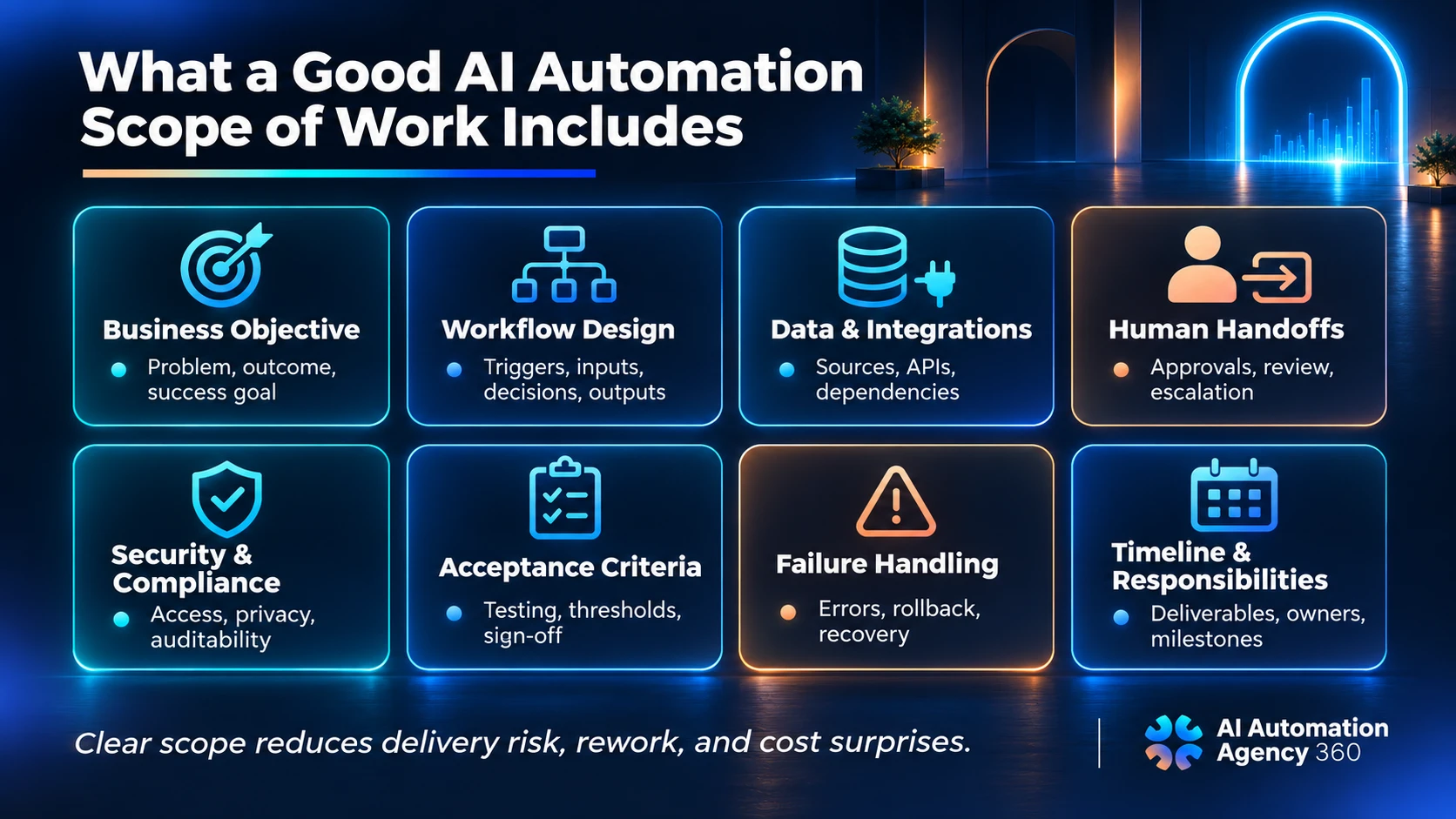
7. Convert the Workflow Design Into an AI Project Scope Document
The final step consolidates the requirements established during discovery into a scope document that both parties can approve.
It should explain what will be built, how the automation should operate, what successful delivery means, and who is responsible for each requirement.
Core components of an AI automation scope document
| Component | What it covers |
| Business objective | Problem and expected outcome |
| Workflow specification | Users, triggers, inputs, decisions, and outputs |
| Human handoffs | Approval and escalation requirements |
| Data and integrations | Sources, readiness, APIs, and dependencies |
| Technical approach | Architecture and alternatives considered |
| Security and compliance | Relevant controls and obligations |
| Acceptance criteria | Performance thresholds and testing |
| Failure handling | Errors, recovery, and rollback |
| Delivery plan | Milestones, responsibilities, and dependencies |
| Assumptions and risks | Technical unknowns |
| Scope exclusions | Explicitly excluded requirements |
| Maintenance and handover | Support, monitoring, documentation, and ownership |
| Costs and timeline | Estimates, assumptions, and commercial terms |
The document's detail should reflect the project's complexity and operational risk.
How should costs and timelines be estimated?
When important requirements remain unresolved, early estimates may need to use small, medium, and large scope ranges rather than unsupported fixed commitments.
Each estimate should identify dependencies such as data preparation, API limitations, integrations, testing, and infrastructure.
Budgets should also distinguish between prototypes, production MVPs, expanded implementations, and ongoing maintenance.
Once the critical requirements are validated, the agency can prepare a specific development proposal.
Expected outcome: An implementation scope containing agreed deliverables, responsibilities, acceptance criteria, timeline, and costs.
Have an automation opportunity but need an implementation scope?
If you've identified a workflow worth automating but lack the technical specifications or reliable cost estimates to approve development, AI Automation Agency 360's 360 Automation Audit can help bridge that gap.
The engagement develops your priority opportunity into an implementation roadmap covering workflow design, data dependencies, architecture, and acceptance criteria, alongside a fixed-price build proposal for leadership review.
Example: What an AI Automation Scope of Work Looks Like
Consider a business that wants to automate incoming lead enquiries.
Employees currently review contact form submissions, assess qualification criteria, and manually enter leads into a CRM.
The objective is to reduce manual processing while keeping sales representatives responsible for customer outreach.
Example AI Project Scope: Lead Intake and Qualification
Business objective: Automate lead capture, initial qualification, and CRM updates while preserving human approval for communications.
| Component | Defined scope |
| Trigger | Prospect submits website contact form |
| Inputs | Name, email, company, industry, budget, and requirements |
| Workflow | Validate, classify, qualify, and prepare CRM data |
| Outputs | Lead summary, qualification score, status, and CRM record |
| Integration | Website form and designated CRM |
| Human approval | Sales representative reviews qualified leads before outreach |
| Acceptance criteria | At least 95% accuracy on agreed classification tests; required fields mapped; no unvalidated CRM updates |
| Failure handling | Missing information flagged; uncertain classifications escalated |
| Out of scope | Automated outreach, advertising, external enrichment |
| Client provides | CRM access, qualification rules, sample records |
| Agency provides | Development, AI configuration, integration, testing, and handover |
The 95% threshold is illustrative. Actual criteria should be agreed during scoping based on the use case.
This example is more actionable than a broad instruction to "build an AI lead generation agent."
It defines the workflow, required information, outputs, controls, and boundaries.
Additional capabilities such as lead nurturing or automated follow-ups can be introduced through subsequent approved scopes.
Common AI Automation Scoping Mistakes That Lead to Project Problems
Even promising projects can encounter delays or cost overruns when important requirements are overlooked.
| Scoping mistake | Why it causes problems | Better approach |
| Choosing technology before the workflow | Creates unnecessary complexity | Define the business process first |
| Treating a prototype as production-ready | Overlooks integration, security, and monitoring | Define separate delivery requirements |
| Underestimating data and integrations | Causes redesign and delays | Validate data quality and API capabilities |
| Using vague acceptance criteria | Creates disagreement over completion | Define measurable pass thresholds |
| Ignoring failure recovery | Leaves operational issues unresolved | Document recovery, monitoring, and ownership |
These problems are easier to address during discovery than after implementation has begun.
How to Evaluate an AI Automation Agency's Scoping Process
An agency's approach to scoping indicates how seriously it manages project delivery.
A good agency should investigate the workflow, validate technical requirements, and define measurable deliverables before asking you to approve a full implementation.
Scoping is only one part of evaluating an automation partner. You should also consider the agency's experience with similar projects, technical capabilities, pricing transparency, workflow ownership, and post-launch support. Our guide on how to choose an AI automation agency explains how to compare providers and assess these factors before making a commitment.
Use these questions when evaluating a proposal.
Has the agency evaluated your current workflow?
Look for evidence that it understands the systems, employees, decisions, exceptions, and bottlenecks involved, not simply the desired outcome.
Can it explain why AI is the right technology?
The agency should distinguish AI agents from conventional automation and justify the recommended approach.
Have technical dependencies been validated?
Ask which data sources, APIs, permissions, and integration capabilities have been reviewed and which assumptions remain unresolved.
What happens when the automation fails?
Look for clear rules covering incorrect outputs, unavailable integrations, approval requirements, and recovery.
How will success be measured?
The proposal should specify evaluation methods, acceptance thresholds, defect handling, and sign-off requirements.
What is included in the quoted price?
Confirm deliverables, exclusions, client responsibilities, change control, and whether the project ends with a prototype, pilot, or production deployment.
Who maintains the automation after deployment?
Establish responsibility for monitoring, failures, updates, model usage costs, and ongoing support.
An anonymized example of an agency's scope documentation can also help you evaluate whether it translates business requirements into specific, testable deliverables.
Scope Your Next AI Automation Workflow With the 360 Automation Audit
Knowing which workflows to automate, whether your systems can support them, and what implementation will cost can be difficult without a structured assessment.
The 360 Automation Audit from AI Automation Agency 360 helps businesses identify high-value opportunities and define implementation requirements before committing to development.
It's a three-week, fixed-fee discovery engagement.
How the 360 Automation Audit works
Week 1: Discover
We work with priority teams to review workflows, systems, and data. An NDA is signed before kickoff, with read-only system access requested where appropriate.
Week 2: Model and Prioritize
We evaluate 10+ opportunities by value, feasibility, and risk, model their potential ROI, and develop the strongest opportunity in greater detail.
Week 3: Roadmap and Readout
We prepare the implementation roadmap, target architecture, security review, and fixed-price build proposal with timelines and acceptance criteria.
What you receive
The audit delivers a ranked opportunity register, process and systems map, technical assessment, priority workflow design, implementation roadmap, and defined build proposal.
Audit investment and commercial terms
The audit costs $4,500 and requires approximately 4–6 hours of your team's time per week over three weeks.
The audit fee is credited toward a production build if you proceed within 60 days.
If we don't identify at least $100,000 in annual value, you don't pay for the audit. The valuation method and applicable guarantee conditions should be documented in the engagement agreement.
Development projects start at $15,000, with the final investment determined by workflow complexity, integrations, and delivery requirements.
Find out which automation opportunities are worth pursuing
Before committing your development budget, establish where automation can create meaningful business value and what implementation will involve.
Book Your 360 Automation Audit
Get a structured assessment and implementation plan before committing to a build.
Frequently Asked Questions About AI Automation Scoping
How long does it take to scope an AI automation project?
Scoping can take a few days or several weeks, depending on the number of workflows, integrations, and technical unknowns. Complex projects involving sensitive data or multiple systems generally require more extensive discovery.
How much does an AI automation project cost?
Costs depend on workflow complexity, integrations, data preparation, security, testing, and deployment requirements.
At AI Automation Agency 360, audits cost $4,500 and development starts at $15,000. See our AI automation pricing for engagement options.
Ongoing hosting, API usage, monitoring, and maintenance should be budgeted separately.
How is AI automation scoping different from traditional software scoping?
AI automation requires additional planning for variable outputs, evaluation methods, data quality, and human oversight.
Acceptance criteria must address output accuracy, exceptions, and authorization rather than relying solely on whether predetermined software functions execute.
Why are AI automation projects difficult to estimate?
Data quality, integration limitations, and the difference between prototype and production requirements introduce uncertainty.
Reviewing sample data and validating technical dependencies during discovery makes estimates more reliable.
Should the scope document change during development?
It can change through an agreed change request. New requirements should be assessed for cost, timeline, and technical impact before implementation.
Which metrics should be monitored after deployment?
Track output accuracy, task completion, processing time, error rate, escalation frequency, and cost per execution.
Compare results against the original baseline and agreed acceptance criteria.
Who should prepare the AI project scope document?
The agency should generally draft the technical scope based on discovery findings.
The client should confirm business requirements, responsibilities, deliverables, timeline, and budget before approving development.