What Does an AI Automation Agency Do?
November 21, 2026 By Team AI Automation Agency 360
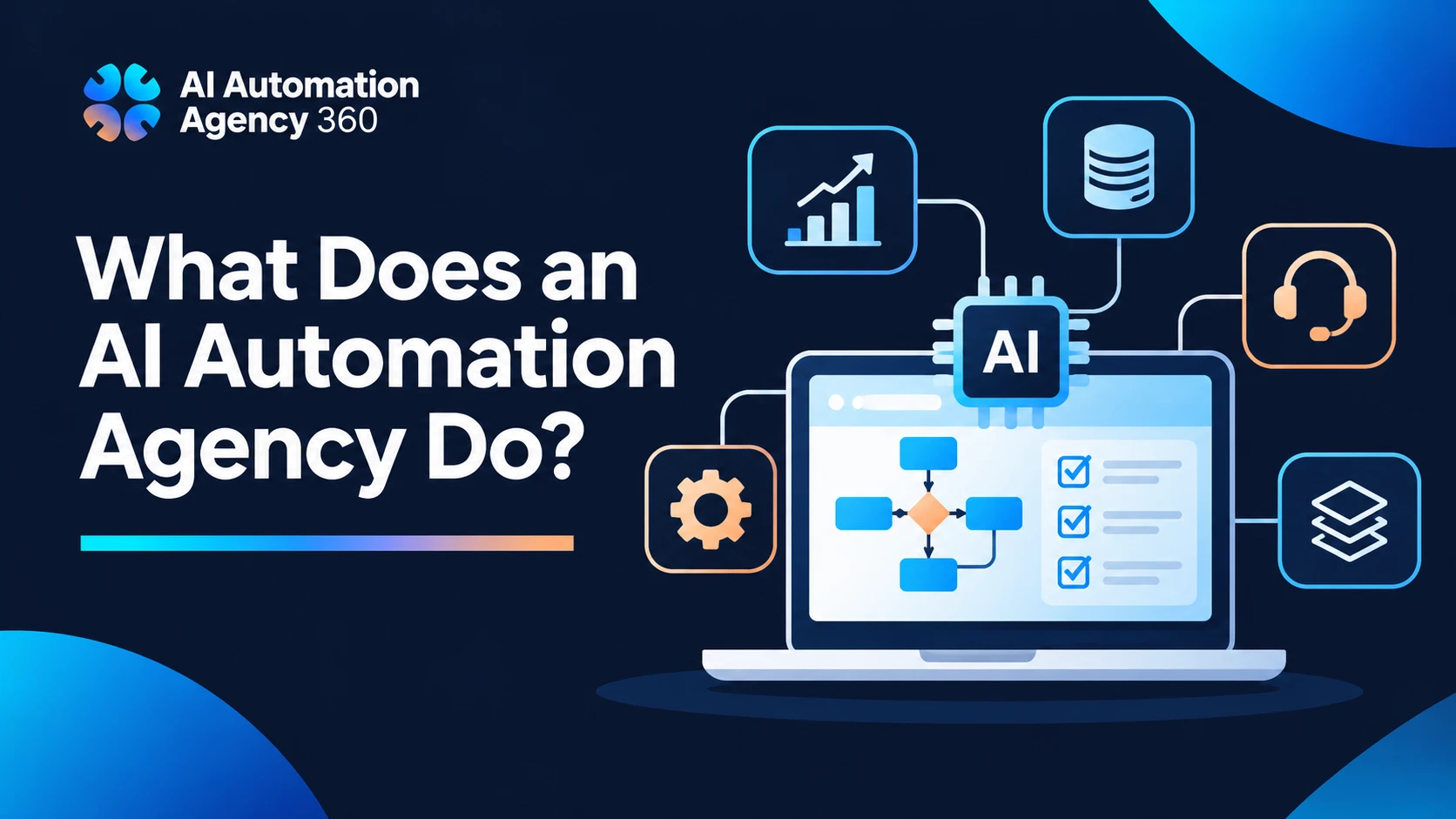
What Does an AI Automation Agency Do? An AI automation agency identifies repetitive business tasks and designs, builds, and maintains AI-powered workflows to handle them. The agency offers services like automation audits, workflow and RPA development, AI agents, chatbots, system integrations, and ongoing monitoring. The goal is to reduce manual work, improve efficiency, and connect existing business systems.
AI tools are easy to find, but putting them to work across your business is a different challenge. AI can handle customer queries, process documents, or support sales teams, but choosing the right tools and connecting them to your existing systems takes time and technical expertise. That is where an AI automation agency can help.
An AI automation agency finds the repetitive, manual work slowing a business down, then designs, builds, and maintains AI-powered workflows to handle it. Services typically include automation audits, workflow and RPA builds, AI agents and chatbots, system integrations and ongoing monitoring, so the business gets results without hiring an in-house AI team.
Turning AI adoption into real business results often starts with improving how everyday work gets done. An AI workflow automation service connects your tools, systems, and tasks to reduce manual work, streamline operations, and free up your team to focus on higher-value priorities.
So, what does an AI automation agency actually do? What services does it offer, and how does the process work? This article breaks down the answers, along with real-world examples, typical costs, business benefits, and what to consider when deciding whether hiring an AI automation agency is worth the investment.
Key Takeaways
- AI automation agencies design, build, and maintain AI-powered workflows that connect business systems and reduce manual work.
- 88% of organizations regularly used AI in at least one business function in 2025, but nearly two-thirds had not started scaling AI enterprise-wide.
- Core services include workflow automation, RPA, AI agents, custom AI development, system integration, and ongoing maintenance.
- Implementation typically takes 2–4 weeks for simple projects and 2–6 months for complex, multi-system deployments.
- Client-reported results from AI Automation Agency 360 include 60% less manual data processing, 30% lower administrative overhead, and 63% fewer onboarding support tickets.
What Is an AI Automation Agency?
An AI automation agency is a technology partner that designs, builds, launches, and maintains AI-powered workflows for your business. Unlike a consulting firm that primarily recommends tools or strategies, an automation agency takes responsibility for implementing the systems and connecting them to your existing operations.
For example, imagine your sales team receives 200 new inquiries each week. Employees manually review each inquiry, check company details, assign a lead score, and update your CRM. An AI automation agency can build you a workflow that captures incoming leads, uses AI to assess their information, enriches their records, and assigns them to the appropriate salesperson automatically.
The need for this implementation support is becoming clearer. McKinsey's 2025 State of AI report found that 88% of surveyed organizations regularly used AI in at least one business function. However, nearly two-thirds had not yet started scaling AI across their enterprises.
The agency also determines which steps need fixed automation rules and which require AI interpretation. This distinction matters because not every business problem needs an AI agent. Sometimes, a straightforward integration or rule-based workflow is faster, cheaper, and more reliable.
AI Automation Agency Services From Strategy to Ongoing Support
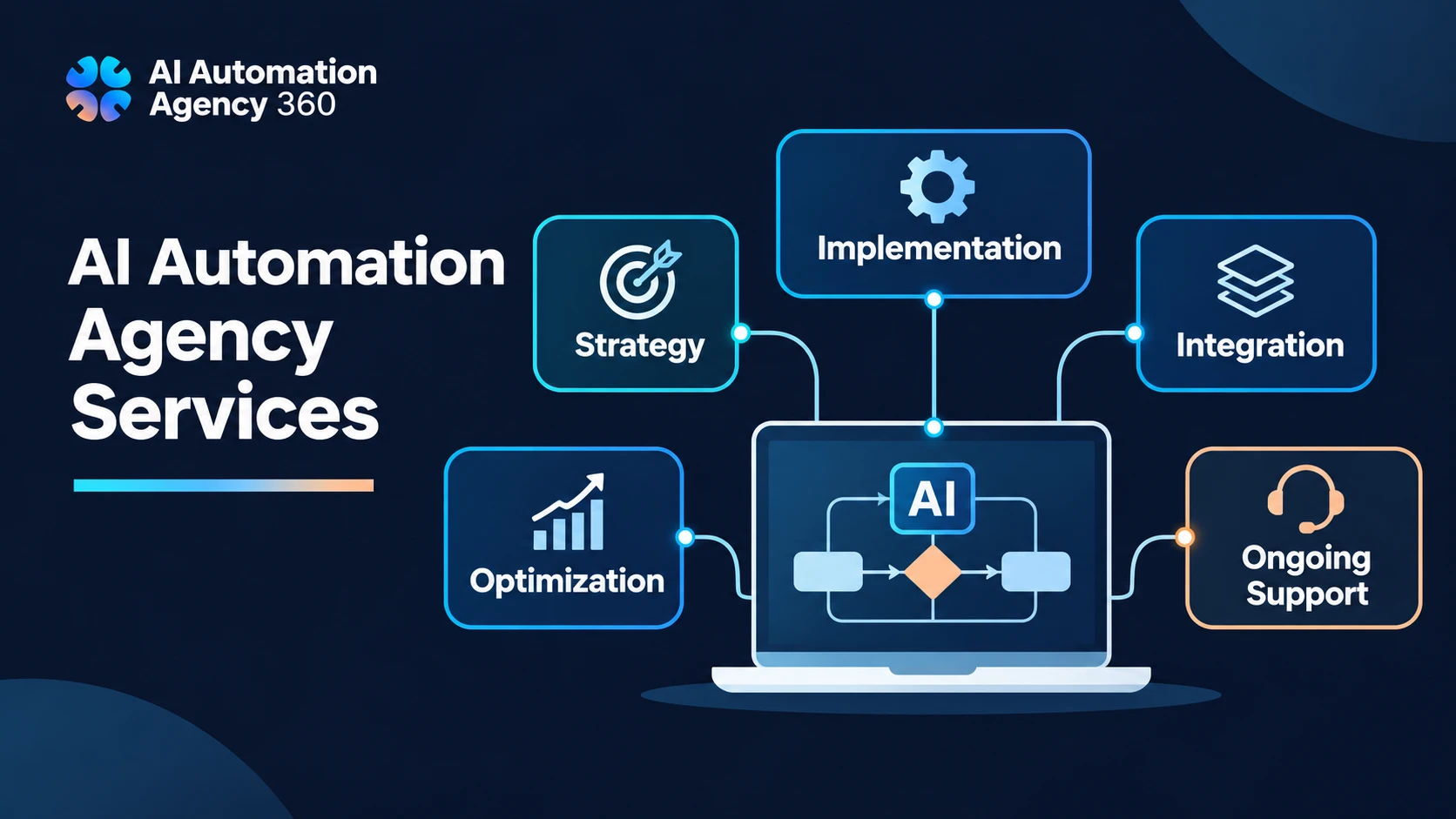
What do AI automation agencies do beyond building individual workflows? They manage the full automation process, from identifying business opportunities and selecting suitable tools to developing custom solutions, integrating existing systems, and providing ongoing support. The exact services depend on your business needs, current technology, and workflow complexity.
AI Automation Audit and Strategy Consulting
An AI automation audit identifies which business processes are worth automating and what implementation will require. The agency assesses existing workflows, software integrations, process bottlenecks, and recurring operational errors to identify opportunities for automation.
For example, if your finance team spends 30 hours each week reconciling invoices across email, spreadsheets, and accounting software, an audit can identify the steps suitable for using AI for automation. It also estimates potential ROI through reduced labor costs, time savings, fewer processing errors, and lower operational overhead against development, software, and maintenance costs.
The resulting roadmap ranks opportunities by business impact, implementation effort, risk, and expected return. Through AI automation audit and AI automation strategy consulting, you can establish a practical starting point instead of investing in disconnected AI experiments.
Workflow Automation
AI workflow automation connects different business applications so information moves between them without repeated manual input. These workflows use triggers, conditional logic, routing rules, and AI decision points to complete tasks across multiple systems.
Let’s take an example of Plane Fax, where we replaced a costly Salesforce-based system with a custom platform for managing advertising orders, listings, and FAA report requests. The project saved more than 1,000 hours annually and reduced maintenance costs by 50%.
Agencies build workflows using platforms such as n8n, Make, Zapier, and Python. The business gains faster processing, less manual coordination, and lower operating costs.
Robotic Process Automation (RPA)
Robotic process automation (RPA) uses software bots to perform repetitive tasks that follow predictable rules. These bots interact with applications, copy information, update records, generate reports, and process transactions in much the same way a human user would.
RPA works best with structured inputs and consistent rules. AI is useful when a process needs to interpret emails, understand documents, or classify unfamiliar requests. We have also delivered AI-powered RPA for a cybersecurity SaaS company, reducing processing time and errors. Combining RPA and AI helps businesses automate more work while improving processing consistency.
AI Agents and Assistants
AI agents and assistants handle tasks that require interpreting information, retrieving context, or choosing between predefined actions. Unlike a basic chatbot that responds to individual questions, an AI agent can work through multiple steps using connected tools and business data.
However, greater autonomy does not always mean greater value. Gartner predicts that more than 40% of agentic AI projects will be canceled by the end of 2027 due to rising costs, unclear business value, or inadequate risk controls. Agencies should assess whether a task needs an autonomous agent or a simpler workflow.
Conversational AI and Chatbot Development
Conversational AI chatbots help you handle customer and employee questions through natural-language interfaces. We build website chatbots, customer support assistants, and internal knowledge bots that retrieve information from approved business sources.
Klarna shows how conversational AI can work at scale. In February 2024, OpenAI reported that its AI assistant handled 2.3 million conversations in its first month, or two-thirds of customer service chats. Klarna also reported 25% fewer repeat inquiries and a reduction in average resolution time from 11 minutes to under two minutes.
A reliable conversational AI chatbot still needs accurate source data, clear response boundaries, and human handoff. These safeguards help resolve routine requests while keeping human support available for complex issues.
AI Integration With Existing Systems
AI integration services connect automation tools and AI models to the software your business already uses. These connections involve APIs, webhooks, databases, or custom middleware.
For example, your business can use Salesforce for customer relationships, an ERP for inventory and financial records, and Zendesk for support. An agency can connect these systems so an AI workflow retrieves information from one application and updates another.
The aim is to extend your existing technology rather than replace every platform. Integration also requires secure authentication, permission controls, data mapping, API limit management, and failure handling. Done well, it gives teams consistent access to information and reduces manual transfers between systems.
Custom AI Development
Custom AI development is necessary when off-the-shelf tools cannot meet your business requirements. An agency develops tailored solutions such as natural language processing (NLP) models, computer vision systems, predictive models, and specialized generative AI applications.
For example, we developed a custom AI solution for a digital agency that reduced its design-to-development turnaround time by 30%. The client also reported a 15% increase in average order value. Tailored development can improve operational speed and commercial performance when the solution addresses a clearly defined business need.
Custom development requires more time, technical expertise, and data preparation than configuring an existing service. The expected business value should justify that investment.
Intelligent Document Processing and Data Entry
Intelligent document processing and data entry uses AI agents and optical character recognition (OCR) to extract information from documents and transfer it into business systems.
The workflow should validate extracted values against purchase orders and flag missing or inconsistent information for review. This reduces manual data entry and processing time while helping finance teams maintain accurate records.
Business Intelligence and Predictive Analytics
AI-powered business intelligence turns operational data into reports, forecasts, and insights that help you make faster decisions. Instead of manually combining information from different systems, your team can receive automated dashboards and scheduled performance summaries.
Forecasts depend on data quality and model performance. An agency should explain prediction assumptions and establish regular reviews so your team can make decisions with greater confidence.
AI-Powered Marketing and Content Automation
AI-powered marketing content automation connects content production, customer segmentation, personalization, and campaign execution. It helps your marketing team manage repetitive work without treating every customer or campaign as identical.
We developed an AI-driven content optimization solution for a viral media company. The workflow recommended content formats, posting times, and captions, helping the team plan content around what its audience engaged with.
AI can help your team improve campaign efficiency and engagement, but marketers should retain control over factual claims, brand messaging, and final publication.
Sales Enablement and Lead Generation
AI lead generation automates repetitive sales activities, including lead capture, data enrichment, qualification, follow-up, and CRM updates.
When a prospect completes a website form, an automation can collect their details, enrich the record using approved data sources, assess fit against qualification criteria, and assign the lead to a salesperson.
An AI-powered student matching and automation platform we developed for Student.com reduced manual workload for the client's team. With clear qualification criteria and regular review, AI lead generation can help sales teams spend less time processing inquiries and more time engaging suitable prospects.
Data Strategy, Security and Governance
Data strategy and governance ensure that your automation systems use accurate information and operate within your business's security requirements. An agency helps to establish data pipelines, access permissions, retention policies, audit logs, and model evaluation procedures.
Your agency should also address data privacy, third-party model processing, bias testing, and relevant regulations. These controls protect sensitive information, reduce compliance risks, and support reliable automation.
Ongoing Maintenance and Optimization
AI automation requires ongoing maintenance because the applications, APIs, data, and models it depends on can change. An agency monitors workflow performance, resolves integration failures, updates prompts, reviews model behavior, and controls usage costs.
A maintenance agreement should define monitoring responsibilities, response times, support coverage, and performance targets. You should also receive system documentation and a clear handover process. This keeps automation reliable after launch and helps protect the value of your investment.
Not sure which service fits your business? Book a free consultation to discuss your current workflows and automation opportunities.
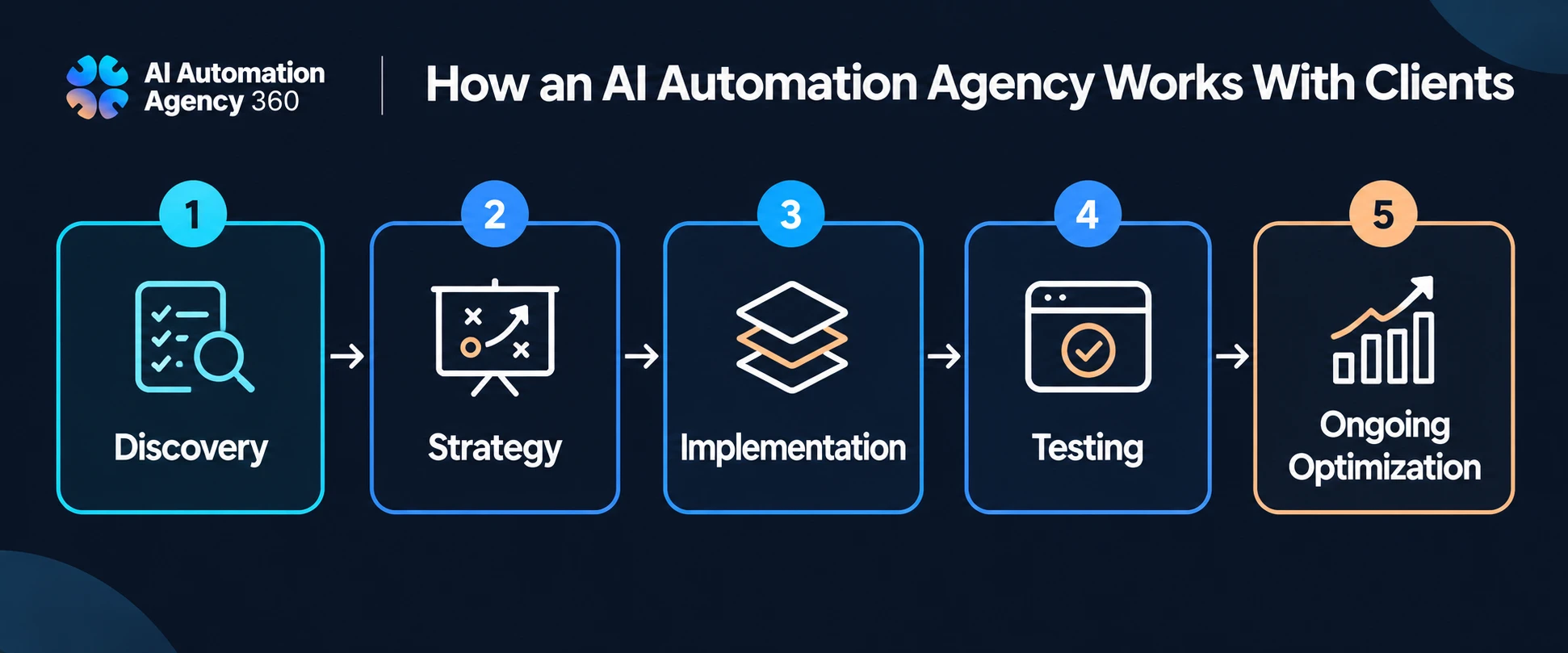
How an AI Automation Agency Works With Clients in Five Stages
An AI automation agency follows a structured implementation process to move your business from manual workflows to tested, production-ready automation. AI Automation Agency 360 follows this approach through an initial consultation, workflow assessment, project planning, done-for-you development, and post-launch support. This approach helps us align each project with your business goals, existing systems, and day-to-day requirements.
Discovery and Workflow Audit
The discovery stage establishes what you need to automate and why. Your agency reviews existing processes, interviews relevant employees, examines your software stack, and identifies where manual work creates delays or unnecessary costs.
A typical discovery and assessment period takes 1 to 2 weeks, depending on the number of departments
and systems involved. You should finish this stage with a documented list of opportunities, baseline performance metrics, and an initial recommendation.
Automation Roadmap and Scoping
Once the agency identifies suitable workflows, it prioritizes them based on business impact, implementation effort and expected return. It then prepares an automation roadmap and defines what the first project will include.
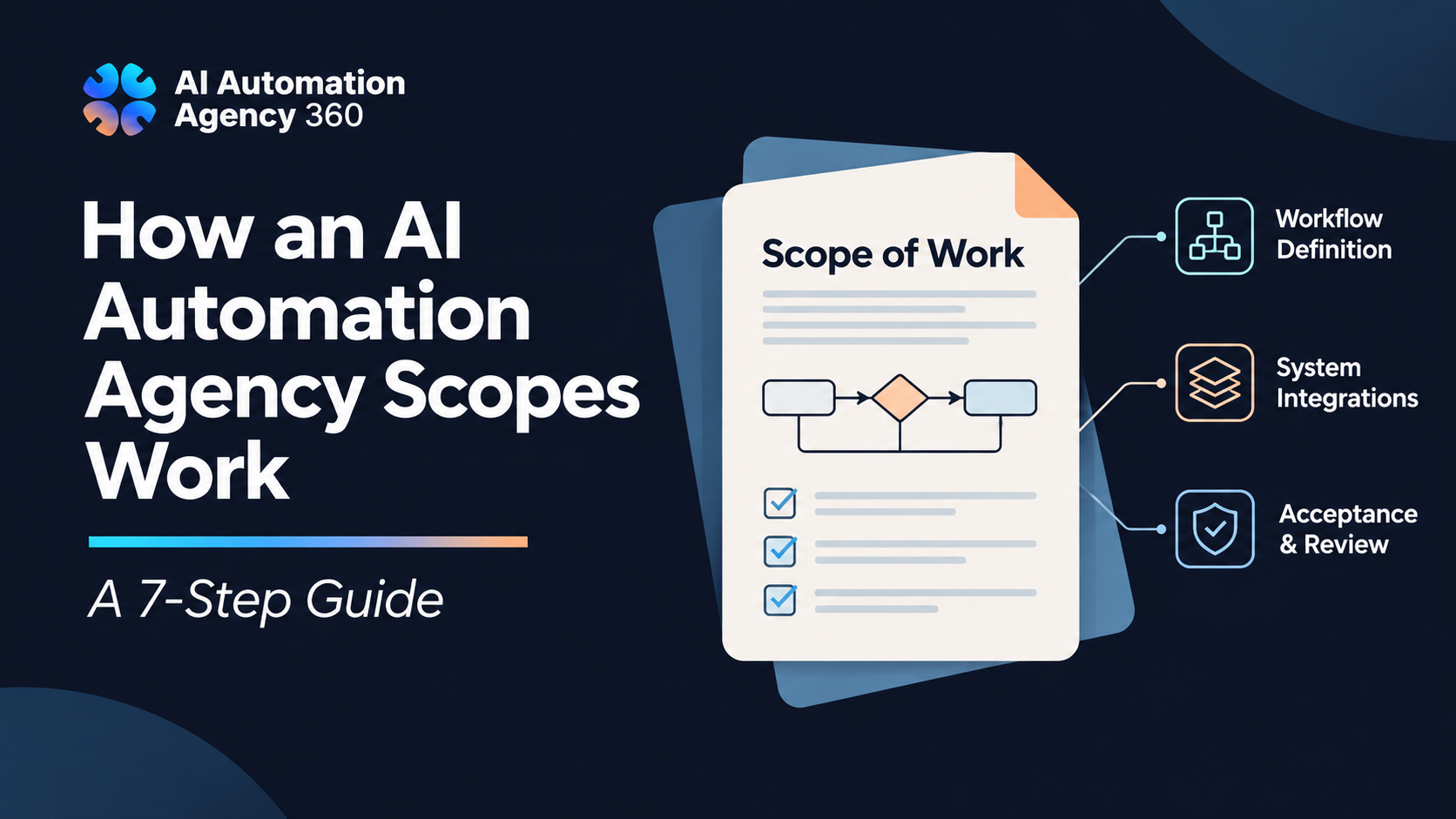
When an AI automation agency scopes work properly, the project scope should specify:
- Business outcomes: What should improve, such as processing time, cost per transaction, or lead response time?
- Data and integrations: Which systems, APIs, and databases will the workflow access?
- Decision boundaries: Which actions can AI perform, and which require human approval?
- Fallback procedures: What happens when data is missing, an API fails, or the model produces an uncertain result?
- Success metrics: How will you measure performance against the existing process?
- Security and ownership: Who can access the system, who maintains it, and who owns the deliverables?
This prevents scope changes and unclear responsibilities during development.
Build and Integration
During development, the agency configures the automation platform, connects APIs, develops AI components, and implements the required workflow logic. For example, while building Audit Caddie, AI Automation Agency 360 integrated AI-powered document analysis into the compliance workflow. This enabled the platform to extract information from company policies, map documents against SOC 2 and ISO 27001 requirements, flag compliance gaps, and update readiness scores automatically.
The agency should test individual components as well as the complete workflow. A successful AI extraction test does not prove that the accounting integration, permissions, or approval process will work correctly.
Pilot, Launch, and Human Review
The agency tests the automation under real business conditions before a wider rollout. A 4-8 week pilot can help assess performance, identify exceptions, and gather employee feedback, although timelines vary by project.
Initially, run the automated workflow alongside the existing process. Compare its results with human-reviewed outputs to catch errors, missing information, and integration failures.
Once it meets agreed acceptance criteria, the agency can expand deployment. Keep human approval for high-impact actions such as financial transactions and changes to important business records until the system demonstrates reliable performance.
Optimization, Training, and Ownership
After launch, the agency monitors performance and trains employees to use the system, review outputs, report errors, and handle tasks that need manual intervention.
You should also receive technical documentation, workflow diagrams, access credentials, and integration instructions. Confirm whether your agreement includes source code, configuration files, model settings, and ownership of custom-built components.
Once the implementation process is clear, looking at practical AI automation agency examples can help you identify workflows worth automating in your own business.
AI Automation Examples by Business Function
AI automation agencies apply different technologies to specific operational problems. The most useful implementations connect several steps in a process rather than automating isolated tasks.
Sales Lead Capture and Follow-Up
Sales teams often lose time manually reviewing and assigning incoming leads. An AI workflow can handle this process. When a marketing manager requests a demo through your website, it checks their company size, industry, and requirements, creates a CRM record, and assigns a sales representative for follow-up.
Use consistent qualification criteria and keep human review in place before rejecting leads based on AI-generated scores.
| Trigger | AI Step | System Action | KPI |
| Website form submitted | Enrich and qualify lead | Update CRM and assign owner | Lead response time |
| New email inquiry | Identify intent | Create sales opportunity | Qualified leads |
| No reply after follow-up | Assess engagement | Schedule next follow-up | Conversion rate |
The key is to use consistent qualification criteria. AI-generated lead scores should support sales decisions rather than automatically exclude prospects without review.
Customer Support Triage
An AI support workflow can classify incoming tickets by issue type, urgency, and customer intent. It can retrieve relevant information, draft a response, and route the request to the appropriate department.
There is also real-world evidence of the productivity opportunity. A 2025 Quarterly Journal of Economics study examined 5,172 customer support agents. It found that access to a generative AI assistant increased issues resolved per hour by an average of 15%. The gains varied across employees, with less experienced workers benefiting particularly strongly.
Document and Back-Office Automation
Document automation helps finance and operations teams process invoices, forms, purchase orders and approvals. An AI system extracts relevant information, checks required fields and transfers verified data into business applications.
Microsoft's Concentrix case study provides a practical example. Concentrix processes more than 100,000 utility invoices monthly from over 100 providers, with more than 300 layouts and multiple languages. Its Power Platform and AI-based solution achieves an average extraction accuracy of 96%.
Internal HR and Operations Assistants
Internal AI assistants help employees find information across company knowledge bases, HR documents, policies, and approved business applications.
You can also connect internal assistants to CRM or project management data, provided access permissions are respected. This makes information easier to find while reducing routine requests to administrative teams.
AI Automation Agency 360's client-reported results include:
- 60% less manual data processing for a nonprofit.
- 30% lower administrative overhead for an education provider.
- 63% fewer onboarding support tickets for a scientific instruments manufacturer.
Benefits of Working With an AI Automation Agency
An AI automation agency helps you improve operational efficiency by combining technical implementation with an understanding of your business processes. The main benefits include:
- Lower implementation costs: An experienced agency helps you choose suitable tools, avoid unnecessary software spending, and build solutions that fit your actual requirements.
- Faster time to value: An established team assesses your needs, recommends the right approach, and manages development and integrations without requiring you to build an internal automation department.
- Scaling with expert support: An agency can adapt your automation infrastructure as transaction volumes, customer inquiries, and business requirements grow, without requiring you to manage every technical change in-house.
- Fewer errors: An experienced agency tests integrations, validates data transfers, and prepares fallback procedures before deployment. These checks help identify failures before they disrupt daily operations.
- Better data-driven decisions: Agencies connect your existing data sources and build reporting workflows that give managers more timely, consistent information about business performance.
- Improved customer experience: An agency can design and integrate customer-facing solutions around your service requirements, helping deliver faster responses and more consistent communication.
- Access to specialist knowledge: You benefit from a team familiar with different platforms, APIs, and implementation challenges, reducing the time spent researching tools and troubleshooting technical issues.
- More maintainable systems: Skilled developers build documented workflows, reusable integrations, and maintainable architecture, reducing reliance on disconnected scripts and temporary fixes.
However, these benefits depend on implementation quality. Automating an inefficient process can make an existing problem happen faster. Your agency should first determine whether the workflow needs to be simplified or redesigned.
Signs Your Business Needs an AI Automation Agency
Based on our experience working with businesses across industries, these are the common challenges that lead companies to seek AI automation support:
- Your teams spend hours on repetitive tasks instead of customer-facing or strategic work.
- Employees manually copy information between CRMs, spreadsheets, emails, and other applications.
- Your processes become slower or less reliable as transaction volumes increase.
- Work regularly moves between several tools or departments, creating delays and communication gaps.
- Your business collects large amounts of data but struggles to turn it into useful insights.
- You have identified a specific bottleneck, such as invoice processing, customer onboarding, or lead follow-up.
- You know AI could help but do not know which tools, integrations, or workflows to prioritize.
- You need a partner to build and deploy working systems rather than simply recommend AI software.
If these problems affect several departments, start by identifying the workflow that consumes the most time or creates the greatest operational risk. You do not need to automate everything at once.
AI Automation Agency vs RPA Vendors, SaaS Tools and In-House Teams
An AI automation agency is best when you need end-to-end implementation across multiple systems, while SaaS tools, RPA vendors, and in-house developers serve different requirements.
| Approach | Best For | Typical Cost | Setup Time |
| AI automation agency | Custom AI workflows, integrations, and managed implementation | $1,500–$12,000 for one workflow; $7,000–$25,000 for multiple workflows; $25,000–$120,000 for custom AI agents | 2–16+ weeks, depending on scope |
| RPA vendor | Structured, rule-based enterprise processes | Varies by vendor and implementation scope | 4–16 weeks |
| SaaS tool (Zapier, Make) | Simple integrations and no-code workflows | $20–$300 monthly for basic DIY automation | Hours to days |
| Custom development shop | Complex software and specialized AI applications | $25,000–$120,000 for custom AI agents; enterprise projects start at $100,000 | 2–6+ months |
| In-house team | Continuous development and long-term internal ownership | $100,000–$300,000+ annually for a small specialist team | Depends on hiring and project scope |
| No-code freelancer | Small, clearly defined automations | $500–$5,000+ per project, depending on scope | Days to weeks |
These are indicative US-dollar budgeting estimates, not standardized industry averages or vendor quotations. Actual costs depend on scope, location, integrations, licensing, and staffing.
A SaaS tool is sufficient for connecting two or three applications through simple triggers and conditions. An in-house team is the right choice when you already have automation engineers with a strong understanding of your systems.
An agency becomes more useful when you need several systems connected, custom AI logic, security controls, and ongoing implementation support. A hybrid approach can also work: your agency builds the initial architecture while your internal team manages routine changes and improvements.
How Much Does an AI Automation Agency Cost?
AI automation agency pricing depends on workflow complexity, integration requirements, data quality, and the level of ongoing support you need. The following ranges provide indicative US-dollar budgeting estimates. They are planning figures rather than fixed market rates.
| Model | Typical Range | What It Covers |
| Discovery or audit sprint | $1,500–$10,000 | Workflow assessment, opportunity identification, ROI estimates, and implementation roadmap |
| Pilot project | $1,500–$12,000 | A limited automation build, testing, and performance evaluation |
| Fixed build fee | $7,000–$25,000 | Custom workflows, integrations, AI components, testing, and deployment |
| Monthly retainer | $1,000–$10,000+ | Monitoring, maintenance, troubleshooting, and optimization |
| Per-workflow or usage-based | $500–$10,000+ per workflow, plus usage costs | Individual automation builds or charges based on executions, API calls, and model consumption |
| Outcome-based | Custom agreement | Fees linked to agreed performance or business outcomes |
These figures exclude some potential expenses, such as third-party software subscriptions, cloud hosting, and AI model usage. AI Automation Agency 360's published pricing provides a concrete example of agency engagement costs. Our 360 Automation Audit is listed at $4,500, with a three-week timeline. Production builds start at $15,000, while ongoing retainers are scoped separately. The audit includes process mapping, a ranked opportunity register, ROI modeling, and an implementation plan.
The final AI automation pricing will depend on four major factors:
- Integration depth: Connecting two applications through existing APIs is generally easier than integrating several legacy systems with different data formats and access requirements.
- Data quality: Inconsistent records, missing fields, and unstructured documents require additional preparation and validation.
- AI autonomy: A system that drafts responses for human approval is generally simpler to implement than an agent authorized to execute multi-step actions independently.
- Post-launch support: Monitoring, security updates, model evaluations, employee training, and ongoing development affect the total cost of ownership.
Before approving a proposal, ask for a breakdown of development costs, software expenses, maintenance fees, and expected business savings.
For a detailed breakdown of available engagement options, explore AI automation pricing.
Industries That Benefit From AI Automation Agencies
Over the years, we've built AI automation solutions and seen strong opportunities across financial services, healthcare, education, manufacturing, and retail. Each industry has distinct workflows where automation can improve efficiency and reduce administrative workloads.
- Financial services: Banks, lenders, and financial firms can automate document verification, transaction monitoring support, customer onboarding, and routine reporting.
- Healthcare: Healthcare providers can streamline appointment scheduling, patient inquiries, administrative documentation, and insurance processing.
- Manufacturing: Manufacturers can automate quality inspection, inventory updates, production reporting, and supplier coordination.
- Retail: Retailers can use AI to manage product information, customer support, order updates, demand forecasting, and personalized marketing.
- Professional services: Accounting firms, legal practices, and consulting companies can automate document processing, client onboarding, meeting summaries, and internal knowledge retrieval.
You can also apply these solutions in nonprofits, education, SaaS, and healthcare administration. For example, a nonprofit automates donor data processing, while an education provider can use AI to reduce administrative work and improve access to funding information.
The most important consideration is not the industry itself. It is whether your processes contain repeatable tasks, accessible data, and measurable outcomes that justify automation.
How to Choose the Right AI Automation Agency
Choose an AI automation agency based on its ability to solve your operational problems, demonstrate measurable results, and support the systems after deployment.
Start by reviewing case studies that explain the original problem, implementation approach, and measurable outcome. Look for experience with the platforms and systems your business already uses.
You should also ask how the agency assesses workflows, estimates ROI, handles integration failures, and manages sensitive data. A credible partner will explain when traditional automation is more suitable than AI and will not recommend complex AI agents for simple rule-based tasks.
Finally, review its project scope, delivery milestones, support arrangements, and ownership terms. Avoid agencies that promise guaranteed savings without first examining your processes. Use these criteria to assess potential partners and follow a structured approach to how to choose an AI automation agency that fits your business needs.
Why Do Businesses Choose AI Automation Agency 360 for AI Automation?
AI Automation Agency 360 combines workflow consulting, custom development, and system integration to help businesses move from automation planning to implementation. Our approach focuses on improving existing operations rather than introducing disconnected tools.
We build done-for-you automation systems using n8n, Make, Python, and APIs. These solutions can connect with your existing CRMs, ERPs, helpdesks, and other business applications.
Our team brings together different areas of expertise:
- Thomas Kwon, Founder and CTO: Holds a PhD in engineering from UCLA and leads technical architecture and engineering.
- Meredith Johnson: Focuses on program delivery, ROI measurement, and change management.
- Chase Lin: Specializes in workflow automation, system integration, and reliability engineering.
This combination helps connect business requirements with technical implementation and measurable outcomes.
We also publish client-reported results. These include a 60% reduction in manual data processing for a nonprofit and 30% lower administrative overhead for an education provider. A scientific instruments manufacturer also reported 63% fewer onboarding tickets. Our website also displays Clutch reviews, an Upwork Top Rated Plus recognition, and AWS certification.
With offices in San Francisco and Los Angeles, AI Automation Agency 360 works with businesses looking to automate operations through practical, maintainable systems.
If you want to identify suitable workflows before committing to development, you can book a free consultation or take our automation readiness quiz.
Frequently Asked Questions About AI Automation Agencies
How long does an AI automation project take?
A simple AI automation project typically takes 2–4 weeks. Projects involving multiple workflows, custom integrations, or complex systems can take 2–6 months. The timeline depends on data readiness, system complexity, testing requirements and the number of departments involved.
How long does it take to see ROI from AI automation?
Most well-scoped AI automation projects can target ROI within 3–6 months of deployment. Actual returns depend on implementation costs, workflow volume, and employee adoption. Track hours saved, error reduction, processing costs, and additional capacity to measure financial impact.
Will AI automation replace my employees?
AI automation is generally intended to reduce repetitive work rather than replace entire teams. It handles data entry, routine reporting and information retrieval, allowing employees to focus on customer relationships, problem-solving and decisions that require human judgment.
Can small businesses afford an AI automation agency?
Yes. Small businesses can start with a single workflow rather than investing in a large automation project. However, agency pricing varies, and simpler requirements are more economical to handle with no-code tools or existing software features.
How does an agency add AI to existing processes without disrupting operations?
An agency first assesses your current systems, then develops and tests integrations in a controlled environment. Running the new workflow alongside the existing process helps identify problems before a staged rollout. Human approval and fallback procedures also protect critical operations.
Who owns the automations and data after the project ends?
Ownership depends on your contract. Before development, clarify who owns custom code, workflow configurations, documentation, and intellectual property. Your business should also retain control of its data, software accounts, credentials, and necessary access permissions.
Conclusion
An AI automation agency helps businesses turn time-consuming manual processes into efficient, connected workflows. Its work goes beyond building automations. It includes assessing business needs, identifying suitable opportunities, integrating existing systems, developing and testing solutions, and supporting them after launch.
You do not need to automate every process at once. Start with one high-impact workflow, define clear success measures, and evaluate the results before expanding. This gives your business a practical way to reduce manual work, manage costs, and improve operations over time.
AI Automation Agency 360 helps you move from workflow assessment to implementation, monitoring, and ongoing optimization. Book a scoping call to discuss your automation needs, explore the right approach, and plan your next steps.