How to Choose an AI Automation Agency for Your Business
October 25, 2026 By Team AI Automation Agency 360
AI promises to take repetitive work off your team’s plate, but turning that promise into real business results takes more than the right tools. It takes the right partner.
However, choosing one isn’t easy. Many businesses choose agencies based on price, chase flashy tools, or overlook integration and post-launch support. The result? Costly rework and broken workflows that still need manual effort.
The challenge is turning AI adoption into business-wide results. McKinsey’s 2025 State of AI survey found that 88% of respondents reported regular AI use in at least one business function, yet nearly two-thirds said their organizations had not begun scaling AI across the enterprise.
This guide explains how to assess your needs, shortlist suitable providers, verify their capabilities, and compare proposals before committing to an implementation.
TL;DR
- Start with one measurable workflow and give every agency the same requirements.
- Evaluate delivery capability through relevant case studies, technical designs, ownership terms, and support arrangements.
- Compare the full cost of equivalent proposals, including the work your own team will still need to do.
- Run a scoped paid pilot and use the results to decide whether to commit to a wider implementation.
To choose an AI automation agency, define the workflow you want to improve and shortlist providers with relevant experience. Verify their results, meet the delivery team, and compare technical designs, security practices, total costs, ownership, and support. Agree on measurable pilot criteria before making a larger commitment.
When Does Your Business Need an AI Automation Agency?
Your business may need an AI automation agency when manual work, disconnected systems, or complex workflows limit growth and your internal team lacks the time or expertise to address them. An agency can help you identify suitable automation opportunities, integrate AI with existing systems, and manage implementation.
You are a good fit when:
- A workflow repeats frequently enough for automation to deliver meaningful value.
- Inputs are messy, unstructured, or spread across multiple systems, and your team needs specialist integration or AI expertise.
- You can measure the desired outcome through cycle time, error rates, throughput, cost, or customer response times.
- Your internal team lacks the capacity or specialized skills to implement, test, and maintain the solution.
Your workflow may not be ready when:
- No one owns the process or can approve changes to it.
- Data is inconsistent, inaccessible, or governed by unclear rules.
- Transaction volume is too low to justify the implementation and maintenance costs.
- You have no baseline against which to evaluate the results.
- The process changes so frequently that its business rules cannot yet be defined.
- A standard software feature or a simple internal automation would solve the problem more economically.
If you already have engineers who can build, test, and maintain the workflow, you may only need specialist advice or a limited implementation engagement. Decide which responsibility you want to hand over before comparing providers.
Define Your AI Automation Needs Before Contacting Agencies
Before contacting AI automation companies, identify the workflow slowing your team down and define the business outcome you want to improve. Understanding what AI automation involves can help you identify which processes need AI capabilities and which can run on simpler, rule-based workflows.
Identify Your Core Business Bottlenecks
Start by looking at the tasks that slow your team down, create recurring errors, or force employees to switch between disconnected tools. Where does your team spend time on repetitive work instead of serving customers or moving the business forward? Look for bottlenecks such as:
- Slow responses to customer inquiries: Your support staff repeatedly answer routine questions or search multiple systems for information instead of resolving customer issues.
- Manual lead qualification: Your sales team spends hours researching prospects, checking lead quality, assigning contacts, and scheduling follow-ups instead of building relationships.
- Repeated CRM and spreadsheet entry: Your employees copy the same information between forms, spreadsheets, emails, and customer relationship management (CRM) systems, increasing the risk of errors and duplicate records.
- Invoice processing: Your finance team extracts details from PDFs, checks purchase orders, reconciles records, and chases approvals, delaying payment cycles.
Choose one workflow with a clear beginning, end, and owner. Avoid asking an agency to automate your entire business in the first engagement. Map the selected workflow from trigger to completion, including handoffs and exceptions. If a process requires employees to make the same decision repeatedly, determine whether that decision follows documented rules or depends on judgment. The former is often easier to automate; the latter may need AI assistance and human review.
Align AI Automation With a Measurable Business Objective
Connect each candidate workflow to a business result such as higher sales capacity, faster customer support, lower processing costs, or fewer billing errors.
Suppose your sales team receives 1,000 inbound leads monthly and spends five minutes routing each lead. That represents roughly 83 hours of routing work per month. If an automation handles most routine assignments, you can estimate the time released, then account for implementation costs, exceptions, and ongoing maintenance.
Automation that saves time but creates another review burden may deliver little net value.
Document the Workflow Baseline and Success Metrics
Record how the workflow performs before automation so you can measure improvement against actual operating conditions. Track relevant metrics before development begins, such as:
- Processing time: Average time to complete each task.
- Error rate: Percentage of tasks requiring correction.
- Manual effort: Staff hours spent completing or reviewing tasks.
- Throughput: Number of tasks completed within a given period.
- Cost per transaction: Total operating cost per completed task.
- Exception rate: Percentage of cases requiring human intervention.
Choose metrics that reflect your workflow’s main business objective. For example, if you automate invoice processing, track processing time, data-entry errors, and the percentage of invoices requiring manual review.
Decide What to Automate, Assist, or Keep Human-Led
Separate tasks that can run automatically from those that need AI assistance or human approval. This distinction determines the system's architecture, risk level, and ongoing operating cost.
- Automate: Predictable actions such as copying validated data, assigning tickets, or sending status notifications.
- Assist: Tasks such as summarizing customer messages, extracting invoice fields, or drafting responses for review.
- Keep human-led: Decisions involving unusual financial commitments, sensitive customer disputes, or consequential judgments that require accountable approval.
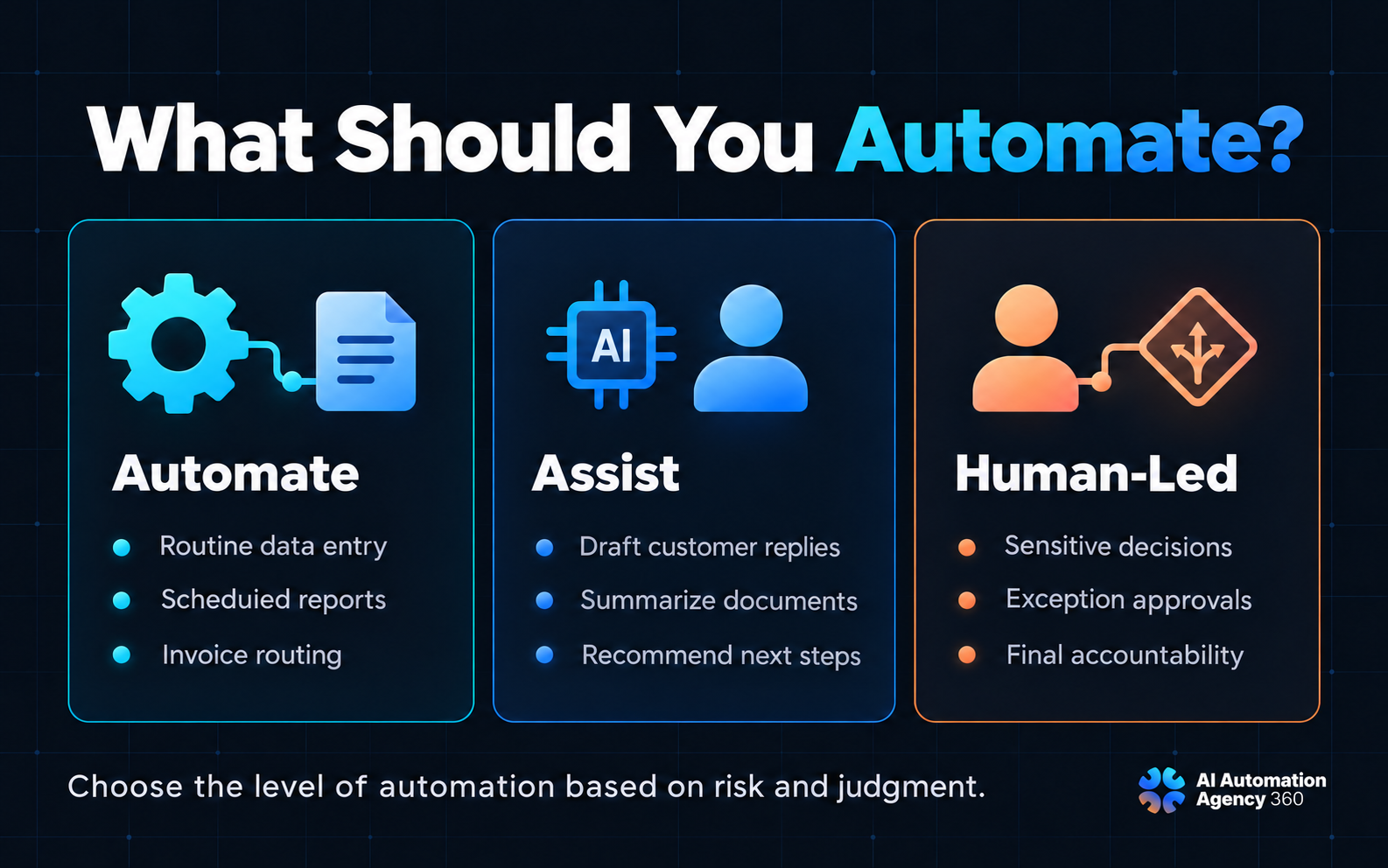
For example, use AI to extract your invoice details and match them against purchase orders, while your finance manager approves exceptions and high-value payments. This approach reduces manual work without giving an AI system unrestricted authority.
Types of AI Automation Agencies and Delivery Models
The best AI automation delivery model depends on your workflow complexity, integration requirements, and internal technical capacity. Straightforward processes can often be handled with existing software, low-code tools, or in-house expertise, making an agency unnecessary. More complex workflows involving multiple systems, custom AI capabilities, or ongoing operational support may require a specialized AI automation partner.
These categories overlap. An engineering-led agency may offer managed support, while a vertical specialist may build with low-code tools. Use the distinctions to identify the capabilities you need.
| Type | Best for | Typical tools | Risk to check | Who owns the build |
|---|---|---|---|---|
| Workflow automation builders | Straightforward, cross-app tasks | Zapier, Make, n8n | Fragile workflows without monitoring | Depends on contract and account setup |
| Vertical specialist agencies | Industry-specific workflows | Sector platforms, integrations, specialist middleware | Proprietary components and lock-in | Must be agreed contractually |
| Engineering-led automation partners | Complex or business-critical systems | Custom integrations, databases, cloud services | Higher costs and scope creep | Defined by intellectual property and handover terms |
| Managed automation services | Ongoing monitoring and optimization | Existing automation stack plus observability tools | Recurring fees or provider dependency | Varies by engagement |
| AI consultants for automation strategy | Opportunity assessment and roadmap development | Process-mapping and analysis tools | Strategy without implementation | Usually advisory deliverables |
| Freelancer | Narrow, well-defined tasks | One or two automation platforms | Limited backup and support capacity | Often negotiable |
Workflow Automation Builders
Workflow builders connect applications through triggers, conditions, and actions. Zapier and Make support visual workflows connecting business applications. n8n combines visual workflows with custom code and self-hosting options. These platforms can deliver value quickly when your process is stable and the connected systems have reliable integrations.
The risk is that a workflow can become difficult to maintain as conditions accumulate. If nobody monitors failed runs, expired credentials, or changes to API responses, small failures can silently interrupt operations. Choose a builder that documents the logic and establishes error alerts, retry rules, and ownership.
Vertical Specialist Agencies
Vertical specialists understand industry-specific processes, terminology, and constraints. That knowledge can be valuable in healthcare administration, financial services, logistics, or e-commerce, where a generic workflow may miss important business rules.
However, examine whether the solution relies on proprietary middleware or undocumented components. Ask how you would migrate the workflow if the agency changed its pricing, discontinued a product, or stopped providing support.
Engineering-Led Automation Partners
Engineering-led partners can build around application programming interfaces (APIs), databases, authentication controls, and business-specific logic rather than forcing your process into a predefined template.
Review our AI agent development services if you need to evaluate a provider for multi-step agents and system integrations.
Managed Automation Services
Separate genuine operational support from fees that exist because the provider controls your accounts or proprietary components. Your contract should specify response times, included changes, usage limits, and what happens when the agreement ends.
AI Consultants for Automation Strategy
Confirm whether the engagement includes implementation-ready requirements, a prioritized business case, and technical recommendations. A strategy document without clear next steps can simply postpone the decision you hired the consultant to help make.
Freelancer vs. AI Automation Agency
A freelancer can be the better choice for a narrowly scoped task, especially when your internal team can review the work and maintain it afterward. An agency is usually more appropriate when several systems must work together, the project needs multiple disciplines, or you require continuing support and documented delivery processes.
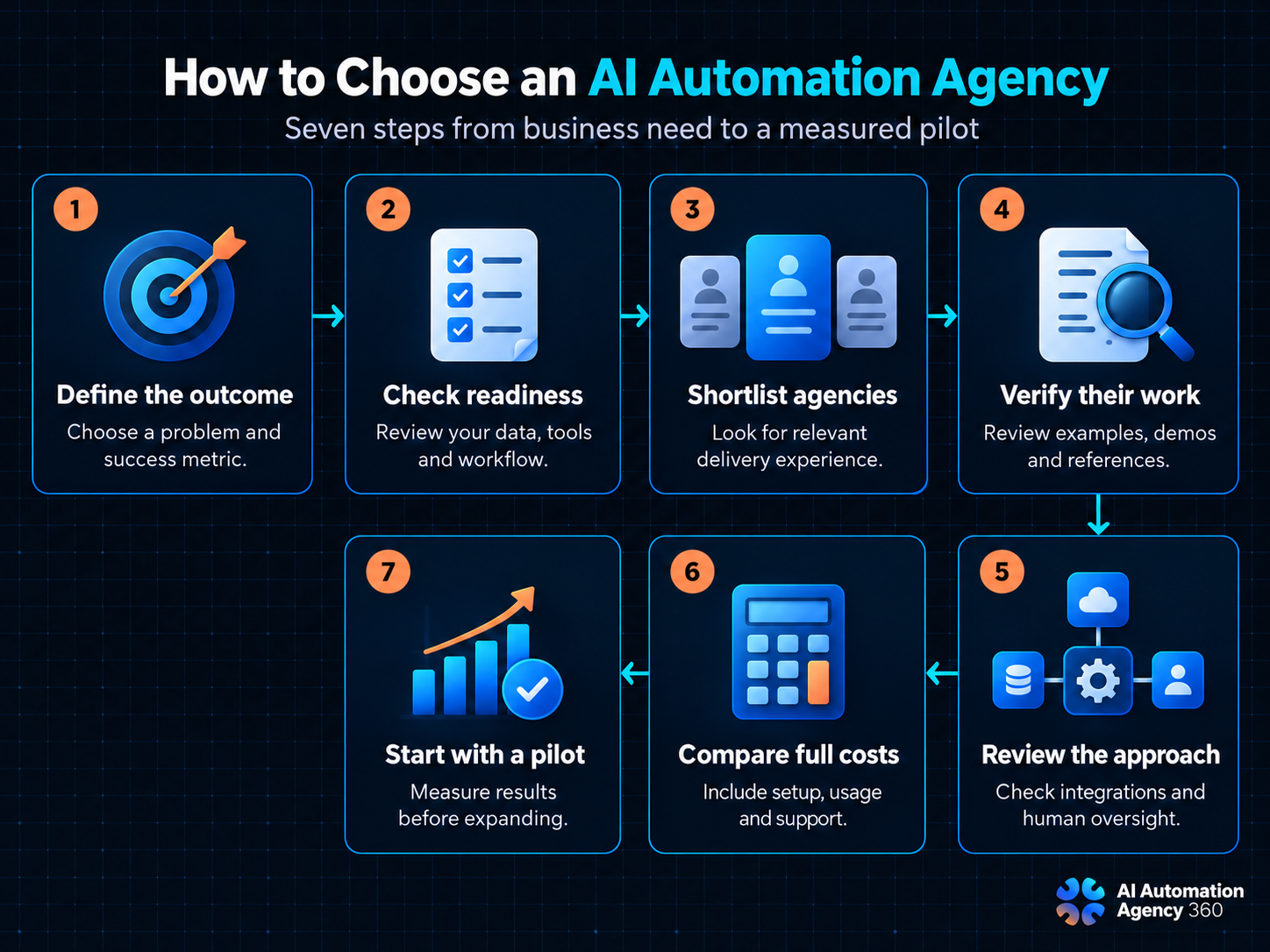
A 7-Step Process for Choosing an AI Automation Agency
Give shortlisted providers the same information, compare the evidence behind their proposals, and make the first commitment small enough to evaluate before expanding.
Step 1: Prepare a One-Page Workflow Brief
Summarize the workflow you want to improve, the systems involved, current transaction volume, and the outcome you want to achieve. Include the process owner, known exceptions, data access restrictions, and any deadline or budget constraints.
You do not need to design the solution yourself. The brief should make the business problem clear enough for agencies to respond to the same task. For example, specify whether invoice processing means extracting data for review or updating the accounting system after approval. Those are different scopes with different responsibilities.
Step 2: Shortlist Agencies by Relevant Workflow Experience
Shortlist three to five agencies that have implemented workflows resembling yours in complexity, industry, or technical requirements. A provider experienced in connecting a CRM to a marketing platform may not be equipped to automate regulated financial approvals across several systems.
Check whether the agency has worked with your current systems, handled similar data, and supported workflows after launch. Establish whether it will deliver the implementation itself or outsource important components.
Step 3: Verify Their Results and Meet the Delivery Team
Request a comparable project example and ask the agency to explain the starting problem, implementation decisions, measured results, and ongoing maintenance. Where possible, speak with a reference client about what happened after launch.
Meet the person who will lead your implementation before making a commitment. Use the meeting to discuss an exception from your own workflow. Their questions should help establish whether they understand the work, what still needs investigation, and which assumptions could change the proposal.
Step 4: Request Comparable Proposals and a High-Level Technical Design
Give every shortlisted agency the same one-page brief and ask for a proposed design. The response should identify the systems involved, integration methods, data flow, AI components, approval points, failure handling, and expected operating costs.
One agency may recommend a lightweight integration using existing APIs, while another proposes a custom agent with additional hosting and maintenance requirements. Either approach could be appropriate, but the provider should explain why. A high-level design may be sufficient during selection, with detailed engineering covered by paid discovery.
Step 5: Compare Scope, Total Cost, Ownership, and Support
Check that each proposal covers the same deliverables before comparing prices. Identify exclusions, client responsibilities, usage assumptions, and any work deferred until after the initial build.
Ask each agency to separate implementation fees from recurring costs and explain how changes will be charged. Confirm who controls the accounts and deliverables, what support includes, and what happens when the agreement ends. Resolve material differences in writing so the cheaper proposal does not win simply because it leaves out necessary work.
Step 6: Agree on a Paid Pilot With Clear Acceptance Criteria
Use a limited, paid engagement to test the preferred agency with representative business inputs, including unusual cases and incomplete data. Agree on acceptance criteria before development begins, and decide who signs off on the results.
Specify the workflow boundary, test inputs, required outputs, review effort, and process for correcting failures.
Our AI workflow automation services provide a starting point for discussing an assessment and implementation engagement. The agreement should still specify your pilot’s deliverables and acceptance criteria.
Step 7: Choose Your Implementation Partner Based on the Evidence
Select the agency whose proposal and pilot results meet your requirements. Record any remaining issues, who will resolve them, and whether they must be closed before production work begins.
A successful demonstration using a handful of clean examples is not enough to establish production readiness. If the pilot misses its targets, investigate whether the problem comes from data quality, integration reliability, process design, or AI output quality before spending more on expansion.
Once the agreed conditions are met, approve the next stage with a defined scope and owner. Expand to more users, transactions, or departments only as production evidence supports it.
Evaluate These 11 Factors When Choosing an AI Automation Agency
Assess each provider against these 11 factors to determine whether it can build, secure, and maintain your automation.
1. Proven Track Record With Measurable Case Studies
Choose an agency that can demonstrate what changed after implementation, not just what it built. A useful case study identifies the original problem, the workflow and systems involved, the implementation approach, and the measured result.
Look for before-and-after figures such as processing time, error rate, throughput, manual interventions, or cost per transaction. Ask whether the numbers represent a controlled pilot or sustained production performance. These are different levels of evidence.
A claim that an AI agent saved hundreds of hours is difficult to evaluate without the original workload, calculation method, and review effort. When possible, speak with a reference client who can explain the project's challenges and ongoing operating requirements. If confidentiality prevents naming a client, the agency should still provide enough detail to make its evidence meaningful.
2. Industry Experience and Compliance Knowledge
An agency should understand the rules affecting your data and business processes. For US healthcare work, establish whether the Health Insurance Portability and Accountability Act (HIPAA) applies to the organizations and data involved. HHS explains that HIPAA rules apply to covered entities and business associates. For personal data, check whether your processing falls within the General Data Protection Regulation (GDPR).
Confirm the relevant controller and processor roles, subprocessors, data storage locations, and retention periods before sharing sensitive data. For regulated workflows, the agency should help document the controls your compliance team requires. You remain responsible for verifying that the final implementation meets your organization's obligations.
3. A Process-First Discovery Phase
A credible agency maps the current workflow before selecting tools. It should understand triggers, handoffs, business rules, exceptions, data dependencies, and the people responsible for each step.
If employees maintain duplicate records because two systems do not agree, adding an AI agent may increase the number of places where incorrect data can spread.
Discovery should produce concrete outputs, such as a workflow map, prioritized use cases, integration requirements, risk assessment, and a measurable pilot scope. The agency should also identify processes that are better handled through conventional automation or process redesign. Ask it to explain where AI adds value and where existing rules or simpler process changes would be sufficient.
4. Technical Capability and Tool-Stack Flexibility
The agency should select technology based on the workflow's complexity, reliability needs, existing licenses, and data sensitivity rather than pushing one preferred platform.
- Zapier fits many straightforward, trigger-based integrations across common business applications.
- Microsoft Power Automate is a natural candidate for organizations already using Microsoft 365, SharePoint, Teams, and related services.
- n8n offers flexible workflow orchestration and self-hosting options, which can suit teams that need more control over deployment.
- UiPath is worth evaluating for enterprise robotic process automation (RPA), particularly when workflows involve legacy applications and repetitive user-interface interactions.
The agency should explain when native integrations are sufficient, when custom APIs are justified, and when a language model adds value beyond deterministic rules. Tool flexibility also helps you avoid rebuilding a workflow simply because a vendor's preferred platform no longer fits.
5. Integration With Your Existing Technology Stack
A workflow is only as dependable as its connections to the systems it relies on. Check the agency's experience with your CRM, enterprise resource planning (ERP) platform, accounting software, document repositories, and internal APIs.
The technical design should specify how records are read and updated, how permissions are managed, and how duplicate events or partial failures are handled. For example, if a CRM update succeeds but a downstream accounting API fails, the workflow should retry safely or create an actionable exception rather than silently losing the transaction.
Ask how the rollout will avoid disrupting live operations. A staged release, limited permissions, test environments, and rollback procedures can reduce risk. The agency should also identify integration limits and third-party fees before you approve the budget.
6. Customization and Scalability of Solutions
A suitable automation should reflect your actual business rules while remaining manageable as transaction volume and process complexity increase. Ask how the design handles additional users, new data fields, more exceptions, and changes in connected systems.
A prototype that works for 20 transactions a day may fail when processing thousands. Volume can expose API rate limits, queue backlogs, concurrency issues, and rising model costs. The agency should test realistic workloads and explain where capacity limits exist.
Customization does not mean building everything from scratch. A well-designed solution may combine standard connectors with a small amount of custom code. The goal is to meet your requirements without creating unnecessary maintenance obligations or a system that only its original developer understands.
7. Data Security, Compliance, and AI Governance
Security must be built into the workflow, especially when AI can read customer records or take actions in business systems. Evaluate access controls, credential storage, encryption, data retention, logging, and the use of your data by third-party AI providers.
Governance must address model behavior. NIST’s Generative AI Profile recommends risk management practices that include human oversight, monitoring, and documentation. Define what happens when the system is uncertain, produces conflicting results, or encounters an unfamiliar input. High-risk actions may require human approval, while lower-risk actions can proceed automatically within explicit limits.
8. ROI Modeling and Outcome Accountability
A credible agency should model return on investment (ROI) using your operating figures and state every important assumption. The model should include implementation, software licenses, model usage, hosting, monitoring, employee review, and maintenance.
Consider a workflow that consumes 100 staff hours each month. If automation eliminates 60 hours of manual work but requires 15 hours of review and maintenance, the net capacity released is 45 hours, not 60. The financial value depends on how you use that capacity and what those hours actually cost.
Ask for a payback estimate and sensitivity analysis showing what happens if volume, accuracy, or adoption falls below expectations. No agency can guarantee every projected outcome, but it should agree on measurable acceptance criteria and explain the corrective process if the system misses them.
9. Workflow Ownership and Vendor Lock-In
Confirm ownership and access before signing, not after the system has been built. Your organization should understand who controls the workflow accounts, source code, prompts, configuration, logs, credentials, and documentation.
Check whether you can export workflows, transfer credentials securely, replace the agency, and continue operating the system without its proprietary services. Define intellectual property (IP) rights, termination assistance, data deletion, and transition fees. A partner that supports a clean handover is easier to trust than one whose business model depends on making departure difficult.
10. Post-Launch Support, Training, and Maintenance
Automation needs ongoing maintenance as APIs change, permissions expire, and business rules evolve.
Your agreement should define support periods, service-level agreements (SLAs), monitoring, response times, and extra charges. Clarify who handles failure alerts and whether monthly fees cover model usage, subscriptions, fixes, and performance reviews.
Your team should also learn to review logs, handle exceptions, pause workflows, and escalate incidents. Without adequate training and knowledge transfer, even minor changes may require paid agency support, increasing long-term costs.
11. A Named Delivery Team You Meet Before Signing
Meet the people responsible for discovery, engineering, testing, and ongoing support before committing. A senior salesperson may understand the promised outcome but have limited knowledge of the technical decisions that determine whether the workflow will succeed.
Ask who will own delivery, who approves architecture changes, and who takes responsibility when an integration breaks. The person leading implementation should be able to explain trade-offs in plain language, while the support team should understand the actual design rather than relying entirely on handover notes.
Ask These Questions Before Signing With an AI Automation Agency
Use these questions in discovery calls and proposal reviews. Ask for evidence or a written commitment where the answer affects scope, ownership, cost, or ongoing responsibility.
| Question | Strong answer | Red flag |
|---|---|---|
| Can you show case studies with specific metrics from similar businesses? | Shares a comparable workflow, baseline, measured outcome, and limitations. | Relies on generic testimonials or unverified percentage improvements. |
| What does your discovery process look like before you recommend anything? | Explains workflow mapping, feasibility checks, and prioritization. | Recommends a tool before understanding your process. |
| Can you provide an ROI model using our numbers? | Shows assumptions, recurring costs, sensitivity analysis, and payback. | Promises guaranteed returns without examining your data. |
| Which integrations have you checked, and what happens when an API fails? | Identifies specific integration methods, failure handling, retries, and alerts. | Assumes every connection will work without interruption. |
| Which decisions stay with our people, and how are wrong AI outputs caught? | Defines approval boundaries, confidence handling, and escalation rules. | Suggests that AI can make every decision without oversight. |
| Whose accounts hold the workflows, data, and credentials after handover? | Explains account access, ownership, IP rights, and export procedures. | Requires permanent control of your accounts or data. |
| What is the full 12-month cost? | Separates implementation, licenses, usage, support, and expected changes. | Quotes only the initial build price. |
| How will we test and accept the build? | Proposes representative test cases, measurable thresholds, and sign-off. | Treats a successful demo as proof of readiness. |
| What does post-launch support look like? | Defines monitoring, response times, maintenance, and escalation. | Offers vague support with no clear scope. |
| Who actually builds this, and will they support it after launch? | Introduces the delivery lead and confirms support responsibilities. | Cannot identify the implementation team. |
| What happens if results miss projections? | Explains root-cause analysis, remediation, and agreed acceptance terms. | Blames the client or model without investigating. |
| Can you walk us through a technical trade-off you made for a client? | Explains alternatives, constraints, costs, and why the chosen design fit. | Gives a tool list without explaining the reasoning. |
| Can you show us how this workflow fails? | Demonstrates failure scenarios, alerts, recovery, and human intervention. | Shows only ideal inputs and successful outputs. |
| Which of your own operations have you automated? | Shares a concrete internal example and what it taught the team. | Cannot discuss practical experience or lessons learned. |
Do not judge an agency solely by whether it gives the answer you want. A technically credible partner may recommend a smaller pilot, reject an unsuitable use case, or explain why conventional automation is safer than an AI agent. Those are signs of sound judgment, provided the reasoning is clear.
How Much Does an AI Automation Agency Cost?
AI automation agency costs depend on workflow complexity, integration requirements, data readiness, and ongoing support. Request a scoped estimate that separates the initial build from the cost of operating and changing it. A general price range is difficult to apply when one proposal covers a simple integration and another includes custom development, testing, training, and managed support.
Agencies may charge through one of these models:
- Setup fee plus monthly support: You pay for discovery and implementation, then a recurring fee for monitoring, maintenance, and improvements.
- Monthly retainer: You pay an agreed amount for continuing development, operational support, or a defined allocation of engineering time.
- Fixed-price project: You pay for a specified deliverable, provided the scope and acceptance criteria remain clear.
Establish what happens when assumptions change. A fixed price needs a change-control process. A retainer needs clear priorities and reporting. A support agreement needs a distinction between correcting defects and adding new functionality.
Compare the full 12-month cost for the same scope, including software licenses, API usage, hosting, support, training, and internal review time. Ask whether the pilot fee is credited toward implementation and whether subscriptions are billed directly to you or passed through by the agency.
For an illustrative comparison, suppose one proposal charges $8,000 for setup and $1,200 per month, while another charges $14,000 for setup and $600 per month. Assuming 12 monthly payments, the first totals $22,400 and the second totals $21,200 before any excluded costs. These figures are an example, not market rates or a quote from AI Automation Agency 360.
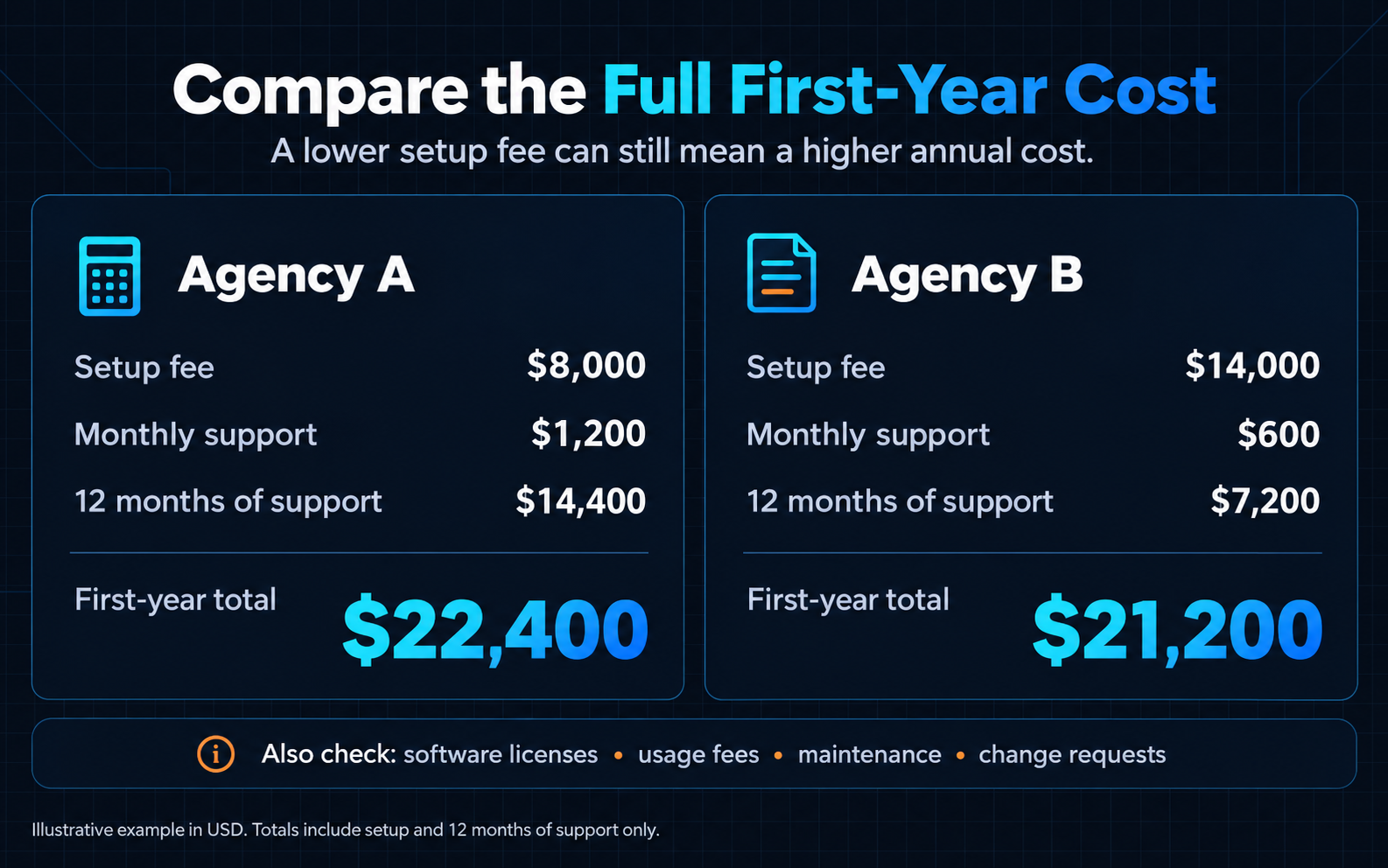
The lower first-year total still needs to be checked against scope. The second proposal could leave your team responsible for monitoring or exclude changes that the first includes. Ask both agencies to price the same workload and support requirements before deciding which offers better value.
Usage assumptions deserve particular attention. A quote based on routine transactions may exclude unusually large documents, repeated retries, additional users, or higher review volumes. Request a base case and a higher-volume estimate, then ask who will monitor spending and alert you when costs approach the agreed limit.
How to Compare Shortlisted Agencies and Make Your Final Choice
Compare agencies against the same requirements, record the evidence behind each assessment, and resolve gaps before making the final commitment. A scorecard helps your team distinguish a convincing presentation from a proposal that meets the actual brief.
Compare Agencies Against the Same Requirements
Use this suggested scorecard during proposal reviews. It is a practical starting point, not an industry standard. Add a column for each agency and record both a score and the document, demonstration, or reference supporting it.
| Criterion | Evidence to compare | What a strong proposal establishes |
|---|---|---|
| Workflow fit | Response to your brief and relevant delivery examples | Understands your process, systems, exceptions, and constraints. |
| Verified results | Case studies, baseline figures, and client references | Can explain how outcomes were measured and what remained manual. |
| Technical approach | High-level design and proposed testing | Justifies the architecture and addresses realistic failures. |
| Security and governance | Data flow, access controls, and approval boundaries | Meets your documented data and operational requirements. |
| Ownership and handover | Account setup, contract terms, and deliverables | Defines what you control and how another provider could take over. |
| Delivery and support | Named team, milestones, support scope, and escalation | Makes responsibility clear during implementation and after launch. |
| Total cost and value | Comparable 12-month estimate and assumptions | Covers the required scope and explains the expected business value. |
For each criterion, use 0 for no evidence, 1 for a verbal claim, 2 for partial written evidence, and 3 for evidence that meets your requirement. Mark unresolved questions separately rather than treating a missing answer as proof of poor capability. Give the agency an opportunity to supply the missing information.
Have the process owner and relevant technical stakeholders assess proposals independently before discussing the scores. Differences often reveal an assumption worth checking. Your finance lead may be counting support as included while your operations lead has understood it to be an additional charge.
Separate Essential Requirements From Preferences
Set mandatory requirements before ranking the agencies. Depending on your workflow, these could include approved data handling, access to your accounts, human approval for sensitive actions, or support during your operating hours.
An agency that cannot meet a mandatory requirement should not win because it scores well on price or presentation. Resolve the issue, narrow the scope, or remove it from consideration. Keep preferences, such as meeting cadence or familiarity with a particular interface, separate from requirements that determine whether the system can operate safely and effectively.
Among agencies that meet the requirements, use the scores to identify trade-offs. A higher fee may be justified by included testing, training, or support that your team would otherwise need to provide. Record the reason for your choice so everyone understands what the decision depends on.
Use Pilot Results to Confirm the Final Choice
Use the pilot to test the assumptions that mattered most in the proposal. Compare measured processing time, corrections, human review, and operating cost with the agreed baseline. Record whether the agency met delivery commitments and how it handled unexpected inputs or failures.
For example, an invoice workflow may process routine documents quickly but send too many cases back to your finance team. Faster processing alone would not establish success if the agreed objective was to reduce total manual effort. Review the complete workload before accepting the result.
Proceed when the evidence meets your acceptance criteria and any remaining issues have an agreed resolution. If no agency meets your requirements, revisit the scope or shortlist. A narrower project or further discovery can be a better next step than accepting an implementation your team cannot confidently use.
Frequently Asked Questions About Choosing an AI Automation Agency
Can I start automations internally before hiring an agency?
Yes, you can start internally by automating simple, repetitive tasks using existing business tools. Test a limited workflow such as data entry, email routing, or report generation, and track time saved, error rates, and adoption. Bring those findings to an agency when the work requires integrations, security controls, or maintenance your team cannot provide.
What should an AI automation agency deliver?
An AI automation agency should deliver the outputs agreed for your engagement. For an implementation, these usually include a documented workflow assessment, solution architecture, working integrations, testing results, deployment documentation, and staff training. A strategy-only engagement will have different deliverables. Confirm the handover package and measurable acceptance criteria before signing.
What is a reasonable ROI timeframe for AI automation?
The time to achieve a positive ROI depends on implementation costs, ongoing expenses, adoption, and the value actually realized. Ask the agency to estimate payback using your workflow figures and show how it changes if benefits arrive more slowly. Hours released create capacity, but they do not automatically reduce payroll costs. Agree on how that capacity will create value before treating it as a financial return.
Do I need clean data before hiring an AI automation agency?
No, your data does not need to be perfect before you hire an agency. However, you should understand where your data resides, who owns it, and how reliable it is. An initial assessment can identify missing fields, duplicates, inconsistent formats, and access issues. Ask the agency to scope necessary cleanup separately and explain which problems must be resolved before development or testing.
Should I hire an AI automation agency or a tech partner?
Choose according to the work and responsibility you need covered. An AI automation agency can suit a defined workflow implementation, while a long-term technology partner can suit ongoing product development and engineering. The labels overlap, so examine the actual delivery team, scope, and support model. An agency offering managed automation may provide the continuing relationship you need.
Conclusion: Choose an AI Automation Agency That Can Prove Its Value
The best way to choose an AI automation agency is to start with a specific business problem and evaluate potential partners on evidence, technical judgment, and accountability. A provider that understands your workflow, integrates with your existing systems, and plans for failures is more valuable than one that simply promises faster automation.
Before making a larger commitment, make sure the proposal, contract, and pilot results tell the same story. You should know what will be delivered, how success will be measured, what your team will own, and who will maintain the system after launch.
You do not need to automate every department at once. Prove that one workflow delivers measurable value, learn from its production performance, and scale when the evidence supports it.
If you are ready to identify your first automation opportunity, contact AI Automation Agency 360 to discuss your current workflow, integration requirements, and a practical implementation plan. Start with the problem you need to solve, then build the right automation around it.